

Supportive Orthopedic Foam
Compare foam construction, firmness, and how easy the sleeping surface is to stand up from.
Learn about foam types →Orthopedic dog bed category
Updated : added the first-week post-purchase fit check.
Start with the buying guide to compare documented bed examples, then use the focused guides below for sleeping space, entry, foam and care decisions.
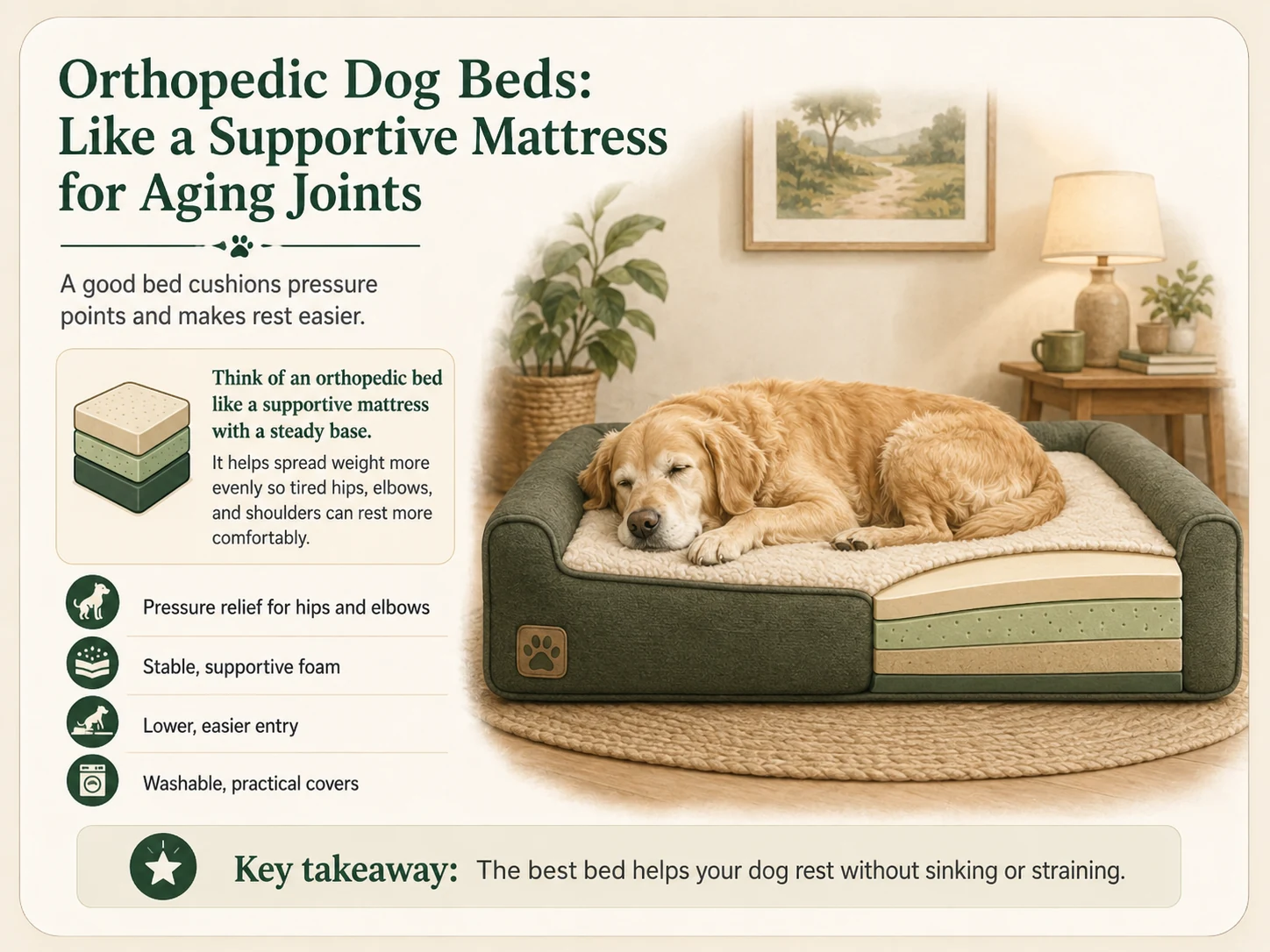
Supportive-mattress analogy
The goal is not simply a thick or soft bed. A useful senior-dog bed spreads weight more evenly, supports the body without excessive sinking, offers easier entry, and stays stable when your dog gets on or off.
What to look for
Compare foam construction, firmness, and how easy the sleeping surface is to stand up from.
Learn about foam types →Open-front or lower-profile designs may reduce the step-over height for dogs with limited mobility.
Learn about fit & entry →Choose enough room for your dog to stretch out and change sleeping positions comfortably.
See the sizing guide →Removable covers simplify routine cleaning and help keep the sleeping area fresh.
Learn about easy-care bed details →A stable bottom can help prevent the bed from sliding when an older dog steps on or off.
Learn about stable footing →Compare sleep style, entry, usable surface, support, stability, and cleaning before choosing a bed shape.
Compare bolster and flat styles →Check the support surface, actual exit, first-step traction, landing room and route before assuming a new mattress is the whole answer.
Run the bed-exit checks →Compare bed height using access, stability, support, temperature, cleaning, fall consequences, and your dog's repeated use.
Compare floor vs. raised →Separate cover care from foam care, compare manufacturer instructions, and decide what to do when the core gets wet.
Check the core before cleaning →Go deeper
Use our five-layer visual and Senior Dog Comfort Test to see beyond the word “orthopedic.”
Explore the anatomy guide →Compare support, bed styles, cleaning, accessibility, and practical shopping considerations.
Read the full guide →Learn how common foam constructions differ and what to compare on product descriptions.
Read the foam guide →Use resting measurements, sleeping style, and entry height to narrow down bed dimensions.
Read the sizing guide →See why outside height is not the same as real support, especially for heavier senior dogs.
Read the thickness guide →Learn what a weight number can—and cannot—tell you about support, bottoming out, size, entry, warranties, and real use.
Read the weight-limit guide →After delivery, check entry, usable space, support under load, heat, stability, route access, cleaning, and current return terms.
Use the first-week fit check →Check the real base material, floor contact, post-wash cover fit, cleaning, edge loading and a 60-second slide test before trusting an anti-skid claim.
Read the non-slip base checklist →Use seven support and safety checks to decide whether the current bed should be kept, refreshed, or replaced.
Read the replacement guide →Compare fabric, seams, zippers, washable layers, replaceable parts and support-retention warranty terms before buying.
Read the durability checklist →Learn why new elbow swelling needs veterinary assessment and how padded, clean, stable bedding fits into a pressure-point care plan.
Read the bedding and pressure-point guide →Accidents, liners & cleaning
For senior dogs with occasional accidents, compare which layer is actually protected, what comes off for washing, where seams and zippers sit, and whether replacement covers or liners are available.
Seven checks for cover claims, liners, seams, care instructions, coverage and replacement parts.
Compare moisture protection →Use the same washability check alongside support, bottom-out, entry and sliding observations.
Use the 5-step check →Connect moisture protection with support, fit, entry and the rest of the bed construction.
Review moisture protection in context →Senior dog comfort
A bed is only one part of the setup. Place it where your dog can reach it without slipping or jumping, keep a clear path around it, and adjust the environment as mobility changes.
← Back to Senior Dog CategoriesSeasonal bed safety
Powered warmth adds a different set of decisions than foam support alone. Review our 7 heated dog bed safety checks for senior dogs before you plug one in.
Latest from the Blog
A senior dog bed can compress normally under weight. These five checks help you tell everyday cushioning from foam that stays flattened, shifts, or no longer supports the way your dog uses the bed.
Read Today’s Foam Recovery Checks →Also useful: compare foam density vs. firmness →
Senior Dog Comfort methodology
Support, bottoming out, entry, sliding, and washability give you a repeatable way to compare a bed without relying on the word “orthopedic” alone.
Use Cooper's Comfort Check →Quick navigation