A heated dog bed can be appealing for an older dog who seeks warm resting spots, especially as cooler weather approaches. But “warm” is not automatically “better,” and a heated bed is not a treatment for arthritis or another medical condition. The practical question is whether your dog can use the product safely and move away from the heat whenever they want.
Current safety guidance is consistent on the biggest risks. The American Kennel Club advises supervision when a heated bed or blanket is switched on. PetMD warns that heated blankets should not be used with a pet left alone and notes that electrical cords can create chewing and electrocution hazards. PetMD also identifies heating pads as a possible cause of contact burns.
Direct answer
Are heated dog beds safe for senior dogs?
They can be a comfort option when the product is made for pets, used exactly as directed, kept dry and undamaged, supervised while powered, and easy for the dog to leave. A heated bed should not be treated as an arthritis treatment or used when a dog cannot move away from the heat reliably.
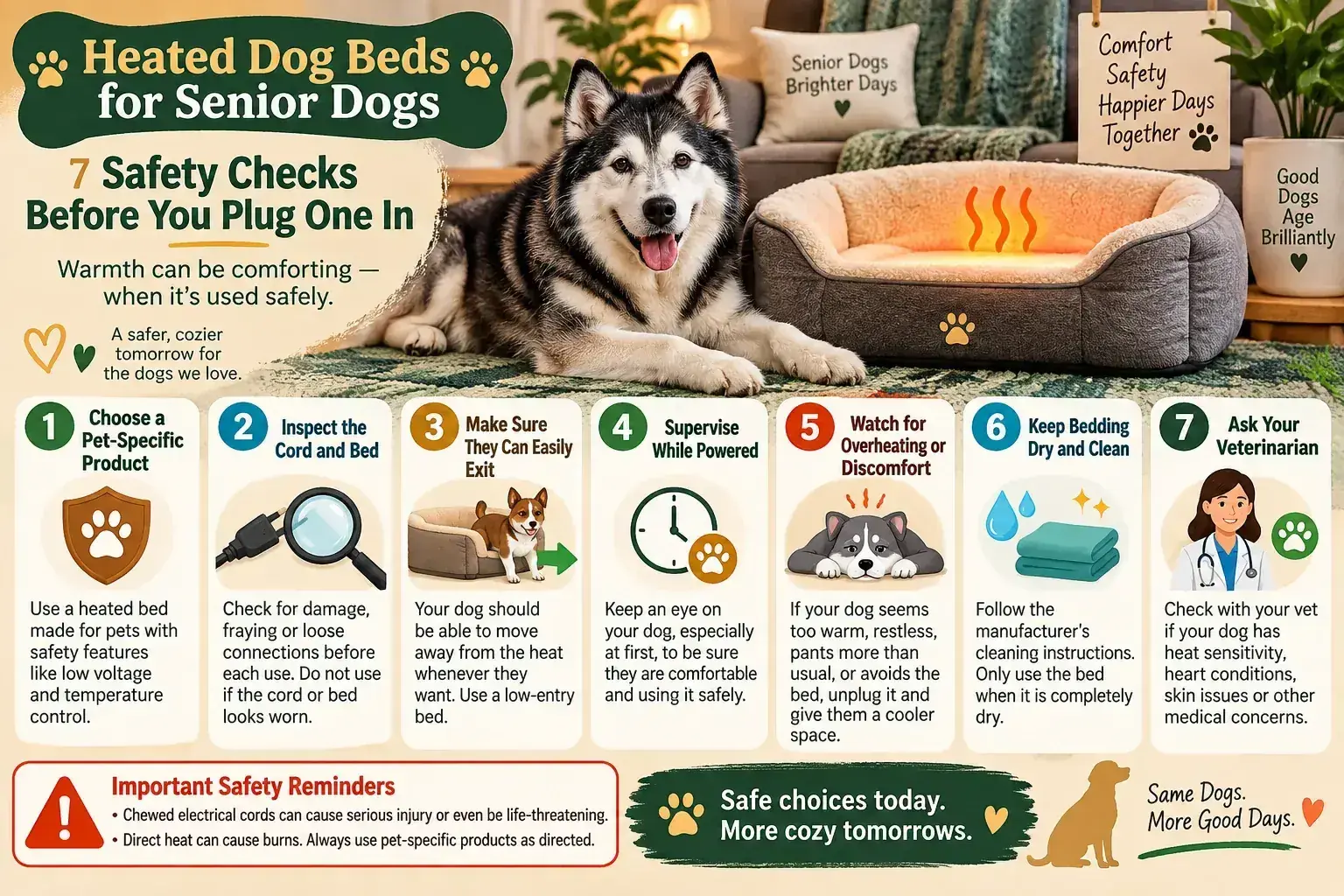
1. Start with a product intended for pets
Use a heated bed or warming product whose manufacturer specifically describes it for dogs or pets, and follow its setup, cleaning, temperature, and supervision instructions. Do not assume that a household heating pad, electric blanket, or improvised heat source works the same way as a pet product. If the label or manual is unclear about how the heat is controlled or how the product should be used, pause before putting it under your dog.
2. Make sure your dog can leave the heat easily
Your senior dog should have a simple, nonslip route off the heated surface and another comfortable place to rest. This matters especially for dogs that are stiff, weak, slow to stand, or reluctant to step over a high bolster. PetMD's blanket-safety guidance specifically recommends making sure a pet can get away from the heated area if they choose.
3. Inspect the cord, connector, and bed before every use
Do not use a powered bed with a frayed cord, exposed wire, damaged connector, wet electrical component, or obvious chewing damage. Electrical-cord chewing can cause burns, electrocution, heart problems, and lung complications. Keep cords routed away from the dog's mouth and normal walking path.
4. Treat supervision as part of the product
A heated bed is not a “plug it in and forget it” item. AKC recommends that heated beds or blankets be switched on under supervision, and PetMD similarly advises direct supervision with heated blankets. Watch how your dog actually uses the bed during the first sessions rather than relying only on the product description.
5. Watch the dog, not just the thermostat
If your dog repeatedly gets up, pants more than expected, seems restless, avoids the bed, or keeps shifting away from the warm area, turn the heat off and provide a cooler resting option. Dogs differ in coat, body condition, health, room temperature, and heat tolerance. A setting that feels mild to you may not be comfortable for every dog.
6. Keep the bed dry, clean, and structurally sound
Follow the manufacturer's washing instructions and make sure removable covers and bedding are fully dry before reassembly. Replace damaged bedding rather than covering up a worn electrical or heating component. Warm, damp bedding is also a poor resting environment, so routine cleaning and drying still matter even when the bed is used mainly for warmth.
7. Ask your veterinarian when heat is being used for a health reason
If you are considering heat because your dog has arthritis, an injury, surgery recovery, reduced sensation, or another medical issue, ask the veterinary team what is appropriate for that dog. PetMD's veterinary guidance on warm compresses notes that heat therapy is not right for every situation and that improper use can damage tissue. A cozy heated bed and prescribed heat therapy are not the same thing.
The 60-second heated-bed check
Before you plug it in
- Confirm the product is intended for pets and read its instructions.
- Give your dog an easy nonslip exit and a cooler alternative bed.
- Inspect the cord, connector, cover, and heating area.
- Keep the dog supervised while the bed is powered.
- Turn it off if your dog seems too warm or uncomfortable.
- Keep the bedding clean and completely dry.
- Ask your veterinarian before using heat for a medical problem.
Bottom line
A heated bed can be a seasonal comfort option, but the useful feature is controlled warmth—not maximum heat. Prioritize easy exit, intact electrical parts, supervision, and your dog's behavior. If the dog cannot move away easily or you cannot supervise the powered bed as directed, a well-insulated unheated orthopedic bed may be the simpler choice.
Sources & evidence context
- American Kennel Club — Dog blanket and heated-bed safety ↗
- PetMD — Blanket Safety for Pets ↗
- PetMD — Electrocution in Dogs: Causes and Prevention ↗
- PetMD — Warm Compresses and Heat Therapy for Dogs ↗
Educational information only. Follow the product manufacturer's instructions and contact your veterinarian about individual medical needs or any suspected burn/electrical injury.