

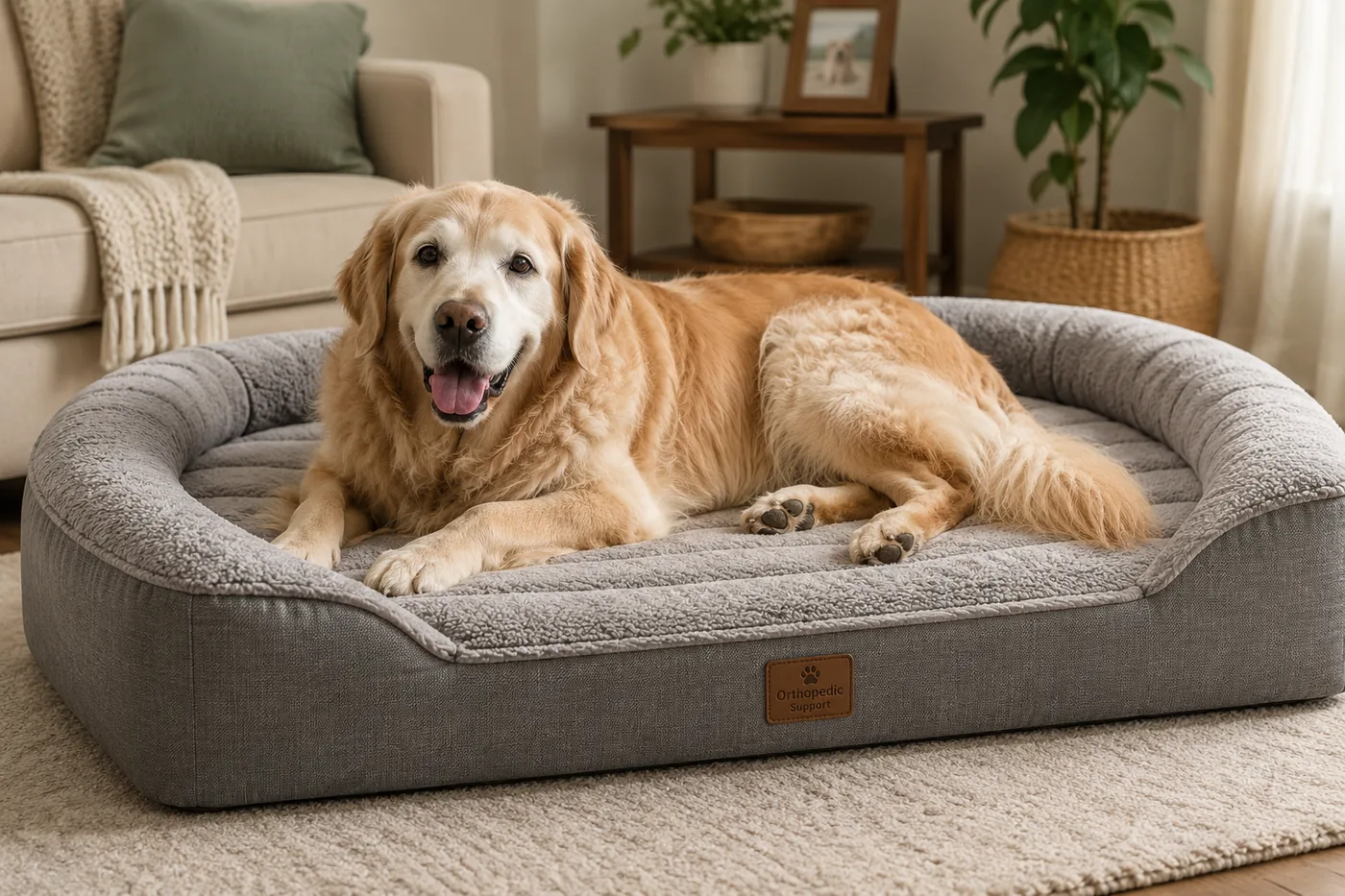
Key takeaway: for a senior dog, durability is not just “can the fabric survive chewing?” A useful bed should also keep its support, tolerate the cleaning your household needs, protect vulnerable seams and zippers, offer replaceable parts where practical, stay stable on the floor, and remain easy enough for your dog to enter and leave.
What “durable” should mean for a senior-dog bed
A bed can fail in several different ways: the cover tears, a zipper becomes a chew target, a seam leaks, the foam develops a lasting dip, a liner becomes damaged, or repeated washing shrinks the cover enough that reassembly becomes difficult. Those are different failure modes, so one marketing word cannot answer all of them.
For older dogs, there is also a tradeoff to watch. A rugged bed that survives scratching is not automatically the best resting surface if the cover is too slick, the edge is hard to step over, the usable sleeping area is too small, or the support core bottoms out. Durability belongs inside the whole-bed decision—not above it.
Seven construction checks before you buy
1. Identify the outer-cover material and its actual use case
Look for a named fabric and a clear description of what the maker expects it to handle. “Heavy-duty,” “ballistic,” “ripstop,” “outdoor,” and “plush” describe very different constructions. Published denier numbers or coatings can add detail, but they still do not create a universal cross-brand durability score.
K9 Ballistics, for example, currently lists 1200D ripstop ballistic polyester on one orthopedic rectangle bed and explicitly positions that model for digging, scratching and light-to-mild chewing—not aggressive chewing. That limitation is as useful as the durability claim.
2. Find the stress points: corners, seams and bolster joins
Dogs often paw, circle, lean or mouth at edges rather than the middle of a mattress. Inspect where fabric panels meet, where bolsters attach, and whether corners expose easy grab points. Moisture protection can also fail at seams even when the face fabric has a resistant coating.
That distinction matters because a cover can be tough against abrasion while still allowing fluid through stitching. Our waterproof bed vs. liner guide handles that moisture question in detail; here, the durability point is to treat seams as components that need their own inspection.
3. Check whether the zipper is exposed, hidden or protected
An exposed zipper pull can become the first thing a curious dog grabs. Some tougher beds recess the closure or cover it with a flap or hook-and-loop strip. K9 Ballistics currently describes a dual-closure system that hides the zipper beneath industrial hook-and-loop material.
A hidden zipper is not a promise that a bed is chew-proof. It simply removes one obvious weak point. If your dog persistently destroys bedding or ingests fabric or foam, product construction becomes a safety issue as well as a replacement-cost issue.
4. Verify what can actually be removed and washed
Frequent cleaning is its own durability test. Confirm whether the outer cover unzips, whether bolsters or inserts come out, what wash temperature and drying method are allowed, and whether the foam itself must stay dry. A bed that survives ordinary use but cannot be maintained in your household may still have a short useful life.
If the care panel is unclear, use our memory-foam dog-bed washing guide to separate cover, liner, bolster and foam instructions before cleaning.
5. Look for replaceable covers, liners or foam—not just a replaceable whole bed
Replaceable parts can extend useful life when one layer wears out before the rest. FurHaven currently sells replacement covers, liners and foam for several bed lines, including a replacement Oxford cover for its Deluxe Mattress line. Barker Beds also sells replacement covers for its Original bed.
That does not prove those beds will last a specific number of years. It does tell you the design is serviceable in a way a sealed, all-in-one bed may not be.
Serviceability check: before buying, search the manufacturer’s site for the exact model name plus “replacement cover,” “replacement liner,” and “replacement foam.” Record which components are sold separately for your exact size and variant. That helps you judge repairability without assuming that replaceable parts make the bed itself more durable.
6. Read foam-retention warranties literally
A warranty is a manufacturer promise with conditions—not independent proof—but specific language is more useful than a vague “long-lasting” claim. Barker Beds currently says its Original orthopedic bed is covered by a 10-year no-flatten warranty and that the foam should retain at least 90% of its original shape and support during that period. Its page also says cover damage, chewing, accidents and misuse are excluded.
K9 Ballistics separately describes a 10-year “won’t flatten” warranty for the solid-foam mattress on the Tough Ripstop rectangle bed, while its damage coverage applies differently to the outer cover. Read exactly which component is covered, how many replacements are allowed, exclusions, and what evidence a claim requires.
If your real question is whether the mattress is supportive enough now, use our thickness vs. support guide and Cooper’s Comfort Check. A warranty cannot tell you how a particular dog experiences a bed.
7. Make sure tougher construction does not create a new access problem
Senior-dog durability still has to work with mobility. Check the lowest entry point, whether the base slides on your floor, whether the cover feels secure under the paws, and whether the dog can turn and stand without catching a foot on a stiff edge. AAHA’s senior-care guidance includes orthopedic bedding and nonslip flooring among environmental modifications for mobility-compromised pets.
Use the low-entry bed checklist and bed-exit checks if access or standing is already changing.
What current listings actually document
| Example | Published durability / serviceability details | What the claim does not establish |
|---|---|---|
| K9 Ballistics Tough Ripstop Rectangle Orthopedic | 1200D ripstop polyester cover, removable cover and liner, hidden zipper system, machine-washable cover, separate cover-damage and foam-retention warranty language. | Not chew-proof for aggressive chewers; seams can admit fluid; no universal guarantee that the surface or entry works for your dog. |
| Barker Original Orthopedic | Removable machine-washable cover, replacement covers sold, three-layer foam construction, 10-year no-flatten warranty language tied to retaining at least 90% of original shape and support. | Cover damage, chewing, accidents and misuse are not part of that foam warranty; the warranty does not prove comfort or fit for an individual dog. |
| FurHaven Deluxe Mattress — Indoor/Outdoor Oxford | Water-resistant coated poly-canvas, zippered removable cover, machine-washable care, replacement cover/liner/foam availability on the maker’s parts pages. | Manufacturer says it is not suitable for excessive teething or destructive chewing; water resistance is not the same as a sealed waterproof system. |
How we separate the evidence
Listing verifiedCurrent manufacturer and retailer pages establish what a specific model or variant says about fabric, closures, care, replacement parts and warranty terms.
Independent contextThe Guardian’s August 2026 hands-on dog-bed test inspected assembly, washing, shrinkage and durability with real dogs. It found meaningful differences between soft comfort and rugged construction.
Veterinary contextAAHA senior-care guidance supports appropriate bedding, nonslip footing and other home modifications for pets with mobility limitations. It does not endorse the products on this page.
Hands-on with CooperNot claimed on this page. We have not performed a controlled durability test of the products shown with Cooper.
Our synthesis: the most useful durability check is component-by-component: outer fabric → seams/corners → closure → removable layers → replacement parts → support-retention terms → access and traction. That approach is more informative than accepting “durable,” “orthopedic,” or “chew-resistant” as a complete answer.
The 60-second durability checklist
- Cover: what fabric is named, and what wear is it designed to resist?
- Stress points: are corners, seams and bolster joins exposed?
- Zipper: is the pull hidden or protected from easy access?
- Cleaning: which parts remove, wash and dry separately?
- Repairability: can you buy a replacement cover, liner or foam insert?
- Support warranty: does it define flattening or shape retention, and which component is covered?
- Senior-dog fit: does the tougher build still provide stable footing, usable sleeping room and an easy route in and out?
Sources & evidence limits
AAHA — Supporting Your Senior Pet: veterinary context for orthopedic bedding, nonslip floors and mobility modifications. The Guardian — dog-bed testing, August 25, 2026: independent hands-on context for washing, durability and comfort tradeoffs. K9 Ballistics — Tough Ripstop Rectangle Orthopedic and warranty policy: manufacturer-stated materials, closures, limitations and coverage. Barker Original Orthopedic and replacement cover: manufacturer-stated foam warranty, care and replaceable-cover details. FurHaven Deluxe Oxford and extra parts: manufacturer-stated cover, care, chewing limitation and replacement-part availability.
Evidence checked September 21, 2026. Manufacturer and retailer claims can change by size, fabric, generation and seller. The examples above are not durability rankings and are not presented as clinical evidence. This article does not diagnose or treat pain, arthritis or mobility disease. New or worsening difficulty standing, limping, weakness, falls or obvious pain deserves veterinary guidance.
View bed options to inspect with this checklist
These are current shopping options, not durability winners. Use the seven checks above on the exact size and variant before buying.


Product photos are shown for recognition. Packaging, price, stock and exact construction can change; verify the current retailer page and selected variant before purchasing.