

Support
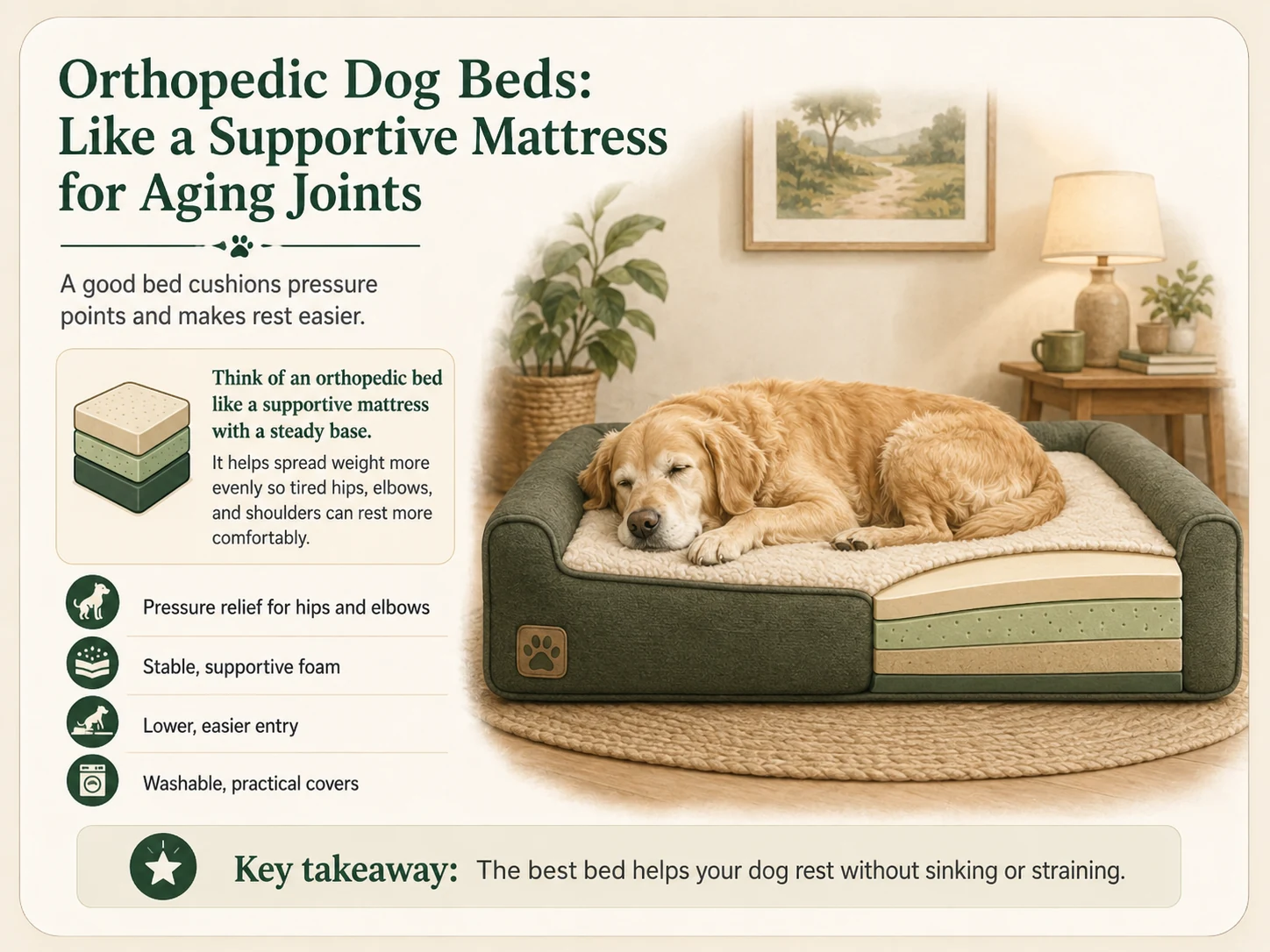
Does the bed cushion without collapsing so far that the dog's body approaches the floor?
Compare the support system →Senior dog bed buying guide
Updated : documented examples and moisture checks added.
Best answer: there is no single orthopedic bed that is best for every older dog. Start with six checks—support, usable size, entry, traction, care, and individual fit—then compare current product details against how your dog actually rests and moves.
Current product evidence
These examples show how to read a product listing before choosing. Each row identifies the version being discussed; size labels such as “Large” are not interchangeable across brands.
Evidence: manufacturer listings checked September 13, 2026. We have not personally tested these beds. Linked sources support the listed details; the questions in the last column are our buying guidance. Dimensions describe the listed product, not a measured medical threshold.
For the evidence trail behind our orthopedic-bed framework, see the orthopedic dog-bed research notes and charts.
| Model and variant | What the listing confirms | What still needs checking |
|---|---|---|
| K9 Ballistics Tough Ripstop Rectangle Orthopedic — Large | 40 × 34 × 5 in (L × W × H). Solid polyurethane foam; removable cover and liner. The cover can be machine washed cold and air dried. | The manufacturer warns that fluid can enter through seams. Listed height is not a measurement under your dog’s weight; check entry and stability in normal use. |
| Barker Original Orthopedic — Sleek Edition, Large | 48 × 30 × 7 in (L × W × H). Flat design; three foam layers listed as 2 + 3 + 2 in. Cover: cold wash, low tumble dry or hang dry. | The 7-in platform is an access consideration. This listing review did not establish liner inclusion or seam protection; confirm those details for the chosen order. |
| Furhaven Quilted Sofa — Large, Convolute Orthopedic Foam | Three bolstered sides and a removable, machine-washable cover. Other foam choices are separate variants. Replacement covers are linked on the product page. | Interior sleeping dimensions and lowest entry height were not verified in this review. A separate water-resistant liner is offered; confirm fit and whether any protection is included. |
Use the comparison: compare the flat platforms when uninterrupted space matters; check interior room when choosing bolsters; ask about seams and liners when accidents are a concern. Confirm the exact size, foam option, current price and return terms before ordering. These examples are not ranked winners.
Cleaning and moisture protection
Record cover, liner and seam details separately when comparing a bed for accidents. A washable cover does not establish protection for the foam beneath it.
| Part to inspect | Question to answer |
|---|---|
| Outer cover | Is the fabric described as water-resistant or waterproof? What washing and drying instructions apply? |
| Inner liner | Is a barrier included or sold separately, and does it enclose the foam and any bolster inserts? |
| Seams and zipper | Does the maker explain possible leakage or seam sealing? Fabric resistance alone does not answer this. |
| Cleaning and replacement | Which parts are removable and washable? Can you buy a compatible replacement cover or liner? |
For example, K9 Ballistics identifies seams as possible fluid-entry points, while Furhaven names its separate liner water-resistant. Follow the exact product’s wording and care directions.
Decision shortcuts
Use simple at-home checks for bottoming out, entry effort, sliding, and resting position.
Run the Comfort Checks →Compare support and compression instead of choosing by foam thickness alone.
Compare Thickness & Support →Measure sleeping posture and usable surface area before relying on a size label.
Use the Sizing Guide →Check sagging, support loss, cover wear, odor retention, and changes in how your dog uses the bed.
Check Replacement Signs →Placement can affect traction, temperature, traffic, and how easily an older dog reaches the resting area.
Choose a Better Bed Location →Use the five-layer anatomy framework to compare the full support system rather than the word “orthopedic.”
Explore Bed Anatomy →Go deeper on listed sleeping space
Compare outside dog-bed dimensions with the usable sleep surface using real manufacturer examples, exact size variants, and questions to ask before ordering.
Read the Bed Dimensions Article →Use the same product criteria on each marketplace. Prices, stock, sizes, and exact variants can change; open the current destination before buying.
| Marketplace | What to check | Open |
|---|---|---|
| Chewy | Current approved affiliate destination, exact size/variant, availability, and product details. | Shop on Chewy → |
| Amazon Associates | Search the same product/topic and confirm the exact listing, seller, size, and return terms before purchase. | Search Amazon → |
Quick navigation