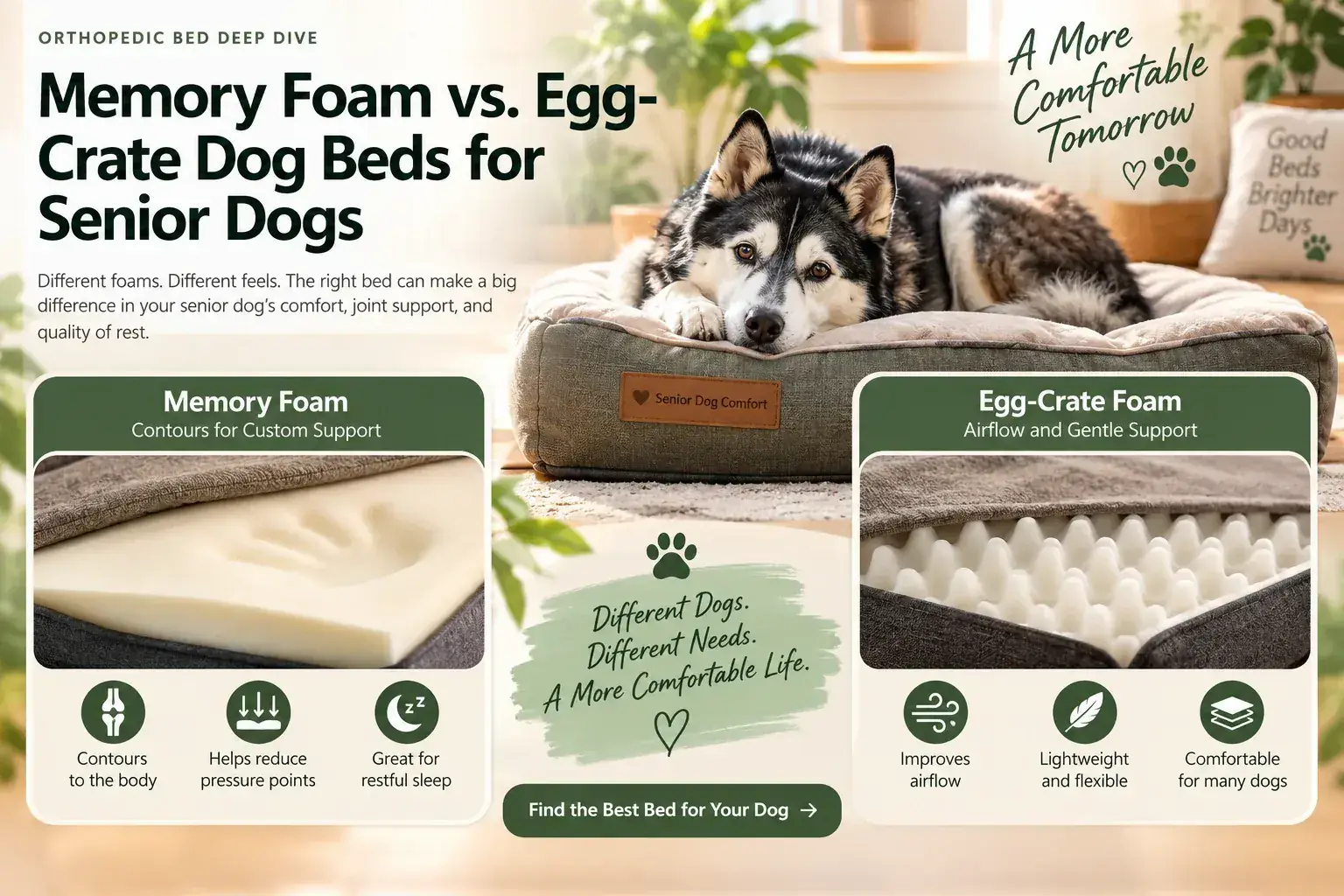
Memory Foam vs. Egg-Crate Dog Beds for Senior Dogs

Product listings use terms like memory foam, orthopedic foam, convoluted foam, and egg-crate foam. Those words describe parts of a construction—not a guaranteed level of support. The useful comparison is how the complete bed is built and whether it suits your dog's size, mobility, sleeping style, and everyday access needs.

What “memory foam” actually tells you

Memory foam is viscoelastic flexible polyurethane foam. Its defining behavior is slow recovery: under load it progressively conforms, and after the load is removed it returns toward its original shape more slowly than conventional resilient foam. That can create a contouring comfort layer, but the words memory foam do not tell you the layer's thickness, density, firmness, or what supports it underneath.

Many beds use memory foam only in the upper comfort layer and a different polyurethane foam as the support core. That layered construction can be perfectly reasonable; it simply means a thick-looking bed should not be assumed to be a solid block of memory foam. Look for a layer-by-layer description and the actual thickness of the sleeping surface.

Another useful distinction is density versus firmness. Density measures mass per unit volume; firmness describes how much force is required to compress the foam. They are related performance variables, but they are not the same specification. A higher density number by itself does not tell you how firm the finished bed will feel because the complete layer stack also matters.

What “egg-crate” or convoluted foam actually tells you

“Egg-crate” usually describes the foam's shape: peaks and valleys are cut or molded into the surface. “Convoluted” is the more technical description for that profile. It does not identify one unique foam chemistry, density, firmness, or quality grade.

The contoured profile creates air spaces and reduces the amount of solid foam at the surface compared with a flat slab of the same outer dimensions. That can change feel, weight, and airflow around the surface, but it does not automatically make a bed cooler or more supportive. The depth of the peaks, the foam beneath them, and the support core still determine how the bed behaves under a dog's weight.

A useful question is whether the convoluted layer is acting as a thin comfort layer over a stable base or as most of the bed's support structure. Two products can both say “egg-crate orthopedic foam” while using very different total thicknesses and base constructions.

Spec terms worth decoding before you compare prices

Total thickness is the full foam depth, while comfort-layer thickness is only the upper layer your dog first compresses. Density is weight per volume and should not be treated as a direct firmness score. IFD/ILD, when a manufacturer provides it, describes the force needed to indent foam by a specified amount and is closer to a firmness measurement. Recovery describes how quickly compressed foam returns toward its original shape. Product listings often omit some of these details, so compare only specifications that are actually disclosed instead of filling gaps with assumptions.


Six details worth checking

Foam type is only one part of the decision. These six checks help you compare the actual sleeping surface, access, fit, care, and stability instead of relying on marketing labels alone.

Total Foam Thickness

Check the thickness of the actual support foam, not only the bed's outside height. Bolsters, quilting, fiberfill, and plush covers can make a bed look tall without adding the same depth underneath the dog's torso. If the manufacturer gives separate layer measurements, add up the layers that actually form the sleeping platform and note whether the lower layer is a firmer support foam.

A thicker bed is not automatically better. What matters is whether the construction has enough usable depth for the dog's weight without compressing so far that hips, shoulders, or the torso approach the floor.

Firmness & Stability

Firmness should be judged together with support and ease of movement. A surface can feel soft at first touch yet become difficult to push up from if the dog sinks deeply; an extremely hard surface can reduce cushioning. The practical goal is a stable sleeping platform that cushions while still giving the dog something predictable to brace against when turning or standing.

Do not use density as a substitute for firmness unless the manufacturer explains both. Density and firmness are separate foam properties, and the finished feel depends on every layer in the bed.

Entry Height

Measure the lowest point your dog must step over, not the tallest bolster. A lower or open entry can reduce step-up effort for an older dog, but the edge should still feel stable enough that it does not collapse or roll when weight is placed on it.

Also check the approach. A low entry does not solve an access problem if the floor directly in front of the bed is slick or if the bed slides away when the dog commits weight to the first step.

Cover & Cleaning

Confirm exactly what is washable: the removable outer cover, a waterproof liner, bolster inserts, or the whole bed. Check zipper placement, washing temperature, drying instructions, and whether foam pieces must be removed before cleaning. A “washable cover” claim is different from a fully washable bed.

For long-term use, also consider how difficult the foam is to reinstall, whether replacement covers are sold, and whether seams, zippers, waterproof layers, and non-slip backing can tolerate repeated cleaning.

Sleeping Position

Use your dog's normal resting posture to judge usable space rather than relying on a size name such as Large or XL. Stretchers need enough interior length and width for the body and paws; curlers may use less open area and may appreciate a stable edge.

Measure the inside sleeping area when bolsters are present. A bed can have generous exterior dimensions while a thick perimeter bolster removes several inches from the flat surface your dog can actually use.

Floor Grip

A non-slip base is useful only if it works on the flooring in your home. Dust, hair, moisture, and smooth hard floors can reduce grip, and some lightweight beds can still move even when the bottom fabric is marketed as non-slip.

Test the whole transition area: approach, entry, turning space, and exit. If the bed shifts, a secure washable traction mat under or around it may be more helpful than relying on the base fabric alone; avoid loose edges that can become a trip point.

Match the foam to the right size and entry height

After you narrow down the construction, make sure the bed dimensions and entry design fit your dog.