


Key takeaway: There is no universal “best” bed height for every senior dog. A floor-level bed can simplify the step-over for a dog with stiff joints or limited mobility, while a raised bed can make sense when a dog prefers getting off the floor, needs more airflow, or benefits from a drier, cleaner sleeping surface. The deciding factor is the whole transfer: approach, step-on, settling, rising, step-off, and the first few feet afterward.
Cooper analogy: think about stepping off a low cushion versus stepping down from a small platform. The platform may look only a little higher to us, but an older dog has to manage that height while shifting weight through four legs. What matters is not whether a bed looks orthopedic. What matters is whether the dog can use it confidently and repeatedly.
Veterinary senior-care guidance supports accessible bedding, good footing, and environmental modification, but it does not set a universal dog-bed height. AAHA specifically includes appropriate beds, traction, and home modifications in senior care; VCA recommends comfortable sleeping areas and mobility-supportive home changes for dogs with osteoarthritis.
Why bed height matters—but does not decide the answer
Bed height changes the mechanics of getting onto and off the sleeping surface. But height is only one part of the system. A low mattress on a slippery floor can be harder to use than a slightly raised platform with a stable, easy approach. A tall platform with a very low front step may be easier than a full-height frame. A thick bolster can create a higher real step-over than the mattress thickness suggests.
That is why this article sits between the site's low-entry bed checks and edge-stability checks: those pages answer narrower questions. Today's gap is the comparison between floor-level versus elevated construction as a whole.

Seven checks for floor-level vs raised dog beds
1. Check the actual step-over your dog uses
Do not measure only the tallest point of the bed. Watch the exact place where your dog gets on and off. An open-front orthopedic bed may have a much lower entry than its side wall. A raised platform may have a low mattress but still require the dog to step down from a frame.
Watch one ordinary transfer without encouraging or pulling your dog. Look for hesitation, a front-paw tap before committing, a jump instead of a step, a scramble, or a change in the way the dog turns. Those observations are more useful than a made-up universal “senior dog bed height” number.
2. Check whether the bed stays put
A low bed is not automatically stable, and a raised bed is not automatically unstable. Push lightly at the edge and watch the base, frame, insert, and cover. The bed should not rock, skid, fold, or bunch when weight shifts.
For floor beds, the floor-to-bed interface matters: smooth hardwood or tile can let the entire bed move. For raised beds, inspect the frame, feet, joints, and floor contact. AAHA and VCA both identify secure footing and environmental modification as relevant to senior mobility.
3. Separate bed height from support
A raised frame does not make a mattress orthopedic, and a floor-level mattress is not automatically too soft. Check the sleeping surface separately: does it stay reasonably even under the dog's usual resting area? Does it bottom out against a hard base? Does the cover or insert shift?
Use the site's bottom-out support checks and foam-recovery checks when the real concern is what happens under load. Height should not become a shortcut for judging foam quality.
4. Check temperature and airflow in the real room
A raised platform can increase airflow underneath the bed and separate the sleeping surface from a cold or damp floor. A floor-level bed can feel warmer and more enclosed. Neither is automatically better: the room, coat, season, bed materials, and the dog's own behavior all matter.
Watch where your dog chooses to rest. If a dog repeatedly leaves a warm, enclosed bed for a cooler spot—or seeks the warmest corner after using a raised platform—that is useful information. For heat-sensitive dogs, also review the site's memory-foam cooling checks rather than treating elevation as a complete cooling solution.
5. Check cleaning, moisture, and access underneath
Raised beds can make it easier to clean the floor beneath them, while floor beds can be simpler to lift, wash, or reposition depending on construction. What matters is whether you can realistically keep the complete sleeping area clean and dry.
Check the cover-removal instructions, liner protection, seams, underside, and the floor underneath. A raised frame that traps hair and moisture under the mattress is not automatically easier to maintain. A floor bed on a damp or hard-to-clean surface has its own problems.
6. Consider what happens if the dog missteps
The higher the sleeping surface, the more important the consequence of an awkward step or fall becomes. This does not mean every raised bed is unsafe. It means the setup should be judged by the dog's current balance, vision, hearing, confidence, and route around the bed.
Keep the area around a raised bed clear. Avoid placing it beside sharp furniture corners or in a tight route where a dog could step off and immediately have to turn. If your dog already struggles with stairs, jumping, or balance, do not assume a raised bed will be easy simply because the top is soft. AKC guidance on senior-home accessibility emphasizes clear routes and traction, while AAHA notes the importance of identifying hazards and improving mobility-supportive environments.
7. Let the dog's repeated choice count
After the physical checks, observe the dog. Does the dog voluntarily return to the bed? Can they settle without repeated repositioning? Do they get up and leave easily? Do they avoid one side, use a corner, or choose the floor beside the bed?
One refusal does not prove the bed is wrong. Dogs may choose a different temperature, location, or social spot. Look for a pattern over ordinary days. If a previously easy transfer becomes hesitant or difficult, treat the change as information rather than forcing the dog to keep using the bed.
Floor-level often helps with: low step-over, simple exit path, lower consequence of a misstep, and dogs that already prefer floor sleeping.
Raised can help with: airflow, separation from a cold/damp floor, easier under-bed cleaning, or dogs that prefer an elevated resting surface.
Either can work when: the base is stable, the sleeping surface is supportive, the route is clear, and the dog can use it comfortably.
Neither is automatically right when: the dog is newly struggling to stand, repeatedly falling, or showing another unexplained mobility change.
Floor-level vs raised: a practical comparison
| Question | Floor-level bed | Raised bed |
|---|---|---|
| Getting on/off | Usually has less vertical step-over, especially when the mattress has an open edge. | Adds a step down from the platform; a low, stable entry is more important than the frame's total height. |
| Stability | Can still slide on smooth flooring; a non-slip base or stable rug may be needed. | Inspect feet, frame joints, wobble, and floor contact. |
| Support | Judge the mattress, layers, and bottom-out behavior independently of height. | Judge both the frame and the mattress; elevation does not prove orthopedic support. |
| Temperature | May feel warmer or more enclosed, depending on the floor and bed materials. | Can increase airflow underneath, but the room and sleeping surface still determine comfort. |
| Cleaning | Often easy to move, but the underside may sit directly on the floor. | Can make the floor underneath easier to reach, but frames and seams still need cleaning. |
A 10-minute home test before you commit
If you are deciding between two beds, test the setup instead of comparing photos alone. Put each bed in the same general area when practical, or compare them in the rooms where they will actually be used.
- Approach: watch how your dog walks toward the bed.
- Step-on: note whether the dog steps, hops, hesitates, or needs help.
- Settle: watch whether the dog can lie down without repeated repositioning.
- Rise: observe one ordinary stand-up without prompting.
- Step-off: watch the first paw placement and whether the dog lands securely.
- Next route: check the first several feet toward water, the door, or the family area.
- Repeat: look for a pattern over more than one transfer.
If the bed is new, give the dog time to investigate it voluntarily. Do not push, pull, or repeatedly make a dog perform a transfer just to “test” the product.
When floor-level or raised may make more sense
Floor-level is worth prioritizing when your dog has difficulty with step-over height, has poor balance, or already prefers lying close to the floor. It can also reduce the consequence of a misstep compared with a higher platform.
A raised design may be worth considering when your dog comfortably uses elevated surfaces, you need more airflow underneath, the floor is cold or damp, or the elevated construction makes cleaning the surrounding floor easier. The key is that the dog must be able to step on and off rather than needing to jump.
These are fit considerations, not medical prescriptions. A veterinarian or veterinary rehabilitation professional can help when mobility is changing, especially if you are unsure whether a dog's difficulty is caused by the environment or an underlying condition.
What not to assume from bed height
- Do not assume higher means more orthopedic. Orthopedic support depends on the mattress construction, not just the frame.
- Do not assume floor-level means safer for every dog. Some dogs find getting up from a very low surface difficult.
- Do not assume a thick mattress has a high entry. The usable step-over may be much lower at an open front.
- Do not assume a raised frame solves heat. Room temperature, airflow, coat, and bed materials still matter.
- Do not assume a single hesitant step proves the bed is wrong. Look for a repeated pattern in ordinary use.
When a bed-height question should become a veterinary question
A new or worsening difficulty getting up, repeated falls, limping, weakness, reluctance to walk, unusual stiffness, repeated inability to settle, or another meaningful mobility change should not be treated as a shopping problem alone. VCA notes that changes such as difficulty getting up and avoiding slippery surfaces can accompany pain in aging dogs, while AAHA recommends environmental modification alongside appropriate veterinary care.
Use a short ordinary video if you notice a change and your veterinarian asks for examples of what happens at home. Do not repeatedly make the dog perform a movement that appears uncomfortable.
3 Bed Options to Compare
These are not “best bed” winners. They are three existing Chewy affiliate options you can inspect with the seven checks above. Verify the exact size, current construction, lowest entry, and current availability before ordering.
These are affiliate links. Senior Dog Comfort may earn a commission from qualifying purchases at no additional cost to you.
 View product →#1Best Raised Senior Dog Beds
 View product →#2Club Nine Pets Roma Elevated Orthopedic Dog Bed
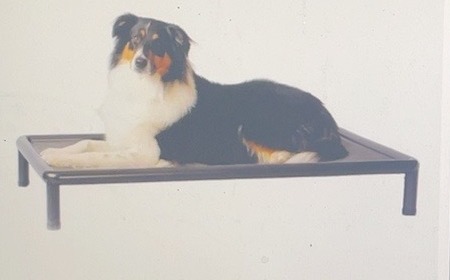 View product →#3Snorehound Chew-Proof Aluminum Frame Elevated Dog Bed, Peppered Paws, Large
Product photos are shown for recognition. Product variants, prices, packaging, stock, and exact construction can change; the current affiliate destination controls what is available.
Evidence limits
There is no veterinary universal pass/fail height for a commercial senior-dog bed. The seven checks above are a practical home-observation framework built from senior-care guidance on accessible bedding, traction, environmental modification, and mobility. They do not diagnose pain, arthritis, balance disorders, or any other condition, and they do not establish that a raised or floor-level bed is medically superior for every dog.
Common questions
Is a raised dog bed better for an older dog?
Not automatically. A raised bed may help with airflow or floor separation, but it also creates a step down. Compare the dog's actual transfer, stability, support, and repeated preference.
Are floor-level beds safer for senior dogs?
They can reduce the vertical step and the consequence of a misstep, but they are not automatically safer. A floor bed can slide, sit on a cold or damp surface, or be difficult for some dogs to rise from.
How high should a raised dog bed be for a senior dog?
There is no universal veterinary height that fits every senior dog. The useful measure is the dog's real step-on and step-off ability in the intended room, including balance and the landing surface.
Should a senior dog bed be on the floor?
It is a reasonable choice when your dog finds a low transfer easiest and the floor is stable, dry, and comfortable. If the dog struggles to rise from very low surfaces or clearly prefers elevation, compare other constructions instead of assuming floor-level is always best.
What if my senior dog suddenly stops using the bed?
Check the bed, room temperature, cover, stability, and route first, but also consider a new mobility or comfort change. A sudden or worsening behavior change deserves veterinary attention rather than repeated bed experiments alone.
Sources & evidence notes
- AAHA — Pain Management: 2023 Senior Care Guidelines. Veterinary context for environmental modification, appropriate beds, traction, and mobility support.
- AAHA — Creating a Senior-Friendly Hospital. Examples of traction, padding, ramps, and hazard reduction for senior pets.
- VCA Animal Hospitals — Helping Your Dog With Osteoarthritis. Comfortable sleeping areas, traction, ramps, and home modifications.
- American Kennel Club — How to Improve Your Senior Dog's Quality of Life. Senior-home accessibility and orthopedic-bed context.
- American Kennel Club — Dog Stairs vs. Ramps. Practical context for elevated access, stability, and senior mobility.
Source review: October 4, 2026. Veterinary sources support accessible bedding, traction, and environmental modification; they do not establish a universal dog-bed height. Product observations are a practical inspection framework, not independent laboratory testing or a veterinary recommendation.