


Quick answer: a senior dog bed is not failing just because the top layer compresses. The useful question is whether meaningful support remains under your dog’s weight and whether the bed still lets the dog settle, reposition, and get up without unusual difficulty.
“Bottoming out” is a practical observation, not a medical diagnosis. It describes a bed compressing so far under load that the support layer is no longer doing enough of the work. A plush comfort layer can compress substantially and still have a stable support core underneath. Conversely, a bed can look thick when empty and provide little useful support once a heavier dog lies on it.
This fills a specific gap between our seven-check replacement audit and our foam density vs. firmness guide: instead of asking whether a bed is “orthopedic” or “thick,” this article shows you what to observe after the bed is loaded by the dog who actually uses it.

What “bottoming out” actually means
Think of the bed as a small support system with several jobs. The upper surface provides cushioning and comfort. Deeper layers provide structure and distribute load. The base keeps the whole system stable. A cover protects the materials and can affect how easily the dog moves across the surface.
When the dog lies down, all of those layers are being tested at once. The heaviest contact areas—often around the shoulders, hips, or chest depending on sleeping position—will compress more than lightly loaded areas. That is expected. The concern is when the useful support seems to disappear under normal use: the bed becomes nearly flat, the dog is effectively resting on the base, or the same deep depression remains after the dog gets up.
There is no universal “minimum thickness” number that can tell you whether every senior dog bed will support every dog. Construction, materials, dog size, body shape, sleeping position, and wear all change the result. Treat listed thickness as one specification, not the final answer.
Seven ways to tell if the support is really working
1. Watch the bed while your dog is fully settled
Start with the simplest test: look at the bed from the side after your dog has been lying down for several minutes. Compare the loaded sleeping surface with an unused edge or corner.
You are not looking for zero compression. You are looking for whether the bed still has a recognizable support layer underneath the dog. If the center is almost flat against the base while the unused portion remains dramatically taller, note that difference.
2. Check the heaviest contact areas
Look where your dog normally places the most weight. If one spot has become a deep permanent hollow, the support may be wearing unevenly. A temporary impression that recovers after unloading is different from foam or fill that remains collapsed.
For a senior dog who changes position frequently, uneven wear can matter even if the rest of the mattress looks new. Check the usual sleeping position and the places your dog uses when turning or stretching.
3. Compare empty height with loaded height
Take a simple measurement before and during normal use. Measure the same point on the bed when empty, then observe that point when your dog is lying naturally. The exact percentage of compression is not a universal pass/fail threshold; the value is in documenting how the bed behaves under the actual load.
If a product has multiple layers, also inspect the insert when the manufacturer permits it. Look for whether the deeper support layer remains intact rather than relying on the outer fabric or plush topper to tell the whole story.
4. Separate softness from loss of support
A soft top layer can be comfortable without being a weak support system. The mistake is treating “soft” and “unsupported” as the same thing.
Press different areas with your flat hand, then compare that observation with what you see while the dog is lying down. A plush surface may compress readily at the hand but still sit on a substantial support core. A worn bed may feel similarly soft but collapse much farther under the dog’s full weight.
For more background, see What Foam Density and Firmness Actually Tell You.
5. Watch what happens when your dog settles and turns
The bed should be evaluated as a place to live, not as a foam sample. Watch the complete sequence: approach, entry, turning, lying down, repositioning, sleeping, and later standing.
If the dog repeatedly fights for a comfortable position, avoids one part of the mattress, slides toward a low spot, or needs several attempts to settle, investigate the whole setup. Those behaviors do not prove the bed is the cause, but they tell you that the environment deserves a closer look.
VCA notes that difficulty getting comfortable, repeated rising and lying down, and other mobility changes can accompany pain in dogs. A new or worsening pattern should therefore be discussed with a veterinarian rather than “fixed” with a bed alone.
6. Check whether the base stays stable
Support is not only vertical. A mattress that shifts, bunches, or twists when the dog turns can make the whole sleep surface feel less predictable.
Test the base on the floor where the bed normally lives. Then watch an actual entry and exit. Our surface-grip guide and non-slip-bottom guide cover the traction side separately.
VCA also recommends improving traction and making sleeping areas easier to access for mobility-compromised dogs.
7. Recheck the bed as your dog changes
A bed can be perfectly adequate one year and poorly matched later without anything “wrong” happening to the product. Your dog may gain or lose weight, become less mobile, prefer a different sleeping position, or simply start using the bed more heavily.
Make the check again when you notice a meaningful change: more repositioning, a new hesitation at the edge, a deeper depression, a new preference for the floor, or difficulty getting up. That is more useful than following a generic replacement calendar.
A five-minute loaded-bed test
- Photograph the empty bed. Take a side view and a top view.
- Let your dog settle naturally. Do not force a particular sleeping position.
- Photograph the loaded bed. Use the same side angle.
- Compare the center and edges. Look for severe compression, permanent hollows, or an uneven slope.
- Watch the exit. Note whether your dog stands and leaves in the usual way.
Repeat the test after several weeks or after a noticeable change. The goal is not to create a laboratory measurement; it is to turn a vague feeling that “this bed seems flat” into an observable record.
What not to assume from one observation
| Observation | What it can tell you | What it cannot prove by itself |
|---|---|---|
| Top layer compresses | The surface is soft or conforming | That the bed lacks deeper support |
| Bed looks thick when empty | There is a certain unloaded height | How supportive it will feel under your dog |
| Deep temporary impression | The loaded area is taking weight | That the foam is damaged |
| Permanent hollow | Possible uneven or worn support | The exact cause without inspecting the insert |
| Dog repositions often | A reason to observe the whole sleep setup | That the bed is the medical cause |
When the bed check should become a veterinary conversation
A bed audit is useful for the environment, but it is not a substitute for evaluating the dog. VCA lists changes such as repeated difficulty getting comfortable, reluctance to rise, trouble on slick floors, reduced activity, and changes in sleep as behaviors that can warrant veterinary attention.
Call your veterinarian if the change is new, persistent, worsening, or accompanied by obvious pain, weakness, limping, repeated falls, major gait changes, or other concerning symptoms. Do not assume that replacing the bed will address a medical problem.
Five foam-recovery checks after unloading
A hand press is only a screening observation. Compare how the bed behaves after ordinary use, and judge the whole support system rather than expecting every foam type to return at the same speed.
- Press and release. With the bed empty, press several areas using similar hand pressure and watch whether each returns toward its usual shape. There is no universal pass/fail number of seconds.
- Compare high-use and low-use zones. Compare the usual sleeping area with an edge or corner that receives less load. A persistent difference can be more informative than one isolated hand press.
- Inspect after normal use. After your dog rests naturally, look for a lasting hollow, shifted insert, damaged seam, or a support layer that appears exposed or collapsed.
- Check the construction beneath the cover. If the manufacturer permits it, inspect the insert and layers. A plush top can compress normally while a deeper support core remains intact.
- Repeat the observation. Record the same areas and angles after a few weeks or after a meaningful change. Consistent observations are more useful than a one-time impression.
Foam recovery alone does not establish that a bed is suitable, and slow rebound alone does not prove failure. Consider support under load, usable sleeping area, entry and exit, base stability, and your dog’s normal behavior together.
Three bed options to inspect
If your current bed fails several of the checks above, these three Chewy options can be starting points for comparing open sleep area, support construction, entry profile, and cover design. Product specifications and available sizes can change, so verify the selected configuration before buying.
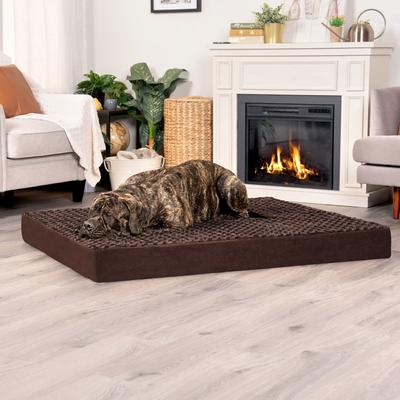 #1
#1 #2
#2 #3
#3Affiliate note: these are affiliate links. Senior Dog Comfort may earn a commission from qualifying purchases at no additional cost to you.
Keep exploring
If your concern is the usable area, see usable sleep area vs. advertised bed size. If the issue is entry height, see low-entry dog beds for senior dogs. If the bed feels unstable, compare bed surface grip and non-slip bottoms. If you are deciding whether to replace it, use the seven-check replacement audit.
Evidence limits
This article combines veterinary guidance about observable comfort and mobility changes with a practical home inspection framework. Product specifications describe what manufacturers/listings say about individual beds; they do not prove how every dog will experience them. There is no universal compression percentage, foam thickness, or replacement interval that should be treated as a diagnosis or guarantee. Our synthesis is intended to help owners observe the loaded bed and decide what deserves a closer look.
Common questions
What does it mean when a dog bed bottoms out?
Bottoming out means the sleeping surface compresses so far under the dog’s weight that the underlying base or floor is effectively taking over the support role. Some compression is normal; the practical question is whether useful support remains under the dog when the bed is loaded.
Is a thicker dog bed always better for a senior dog?
No. Thickness by itself does not tell you how a bed will behave under a particular dog. Construction, foam or fill, firmness, density, layered design, the dog’s size, and how the bed is used all matter.
How can I check a dog bed for bottoming out at home?
Watch the bed from the side while your dog is lying in its normal position. Compare the loaded surface with an unused area and inspect the insert when the cover is removed if the manufacturer allows it. Look for near-flat compression, permanent hollows, damaged layers, or support that changes dramatically between areas.
Should I replace a bed if my senior dog sinks into it?
Not automatically. Some soft top layers are designed to compress. Look for whether the dog remains supported, can reposition normally, and can rise and exit without unusual difficulty. If the core is damaged or the bed no longer matches the dog’s mobility needs, replacement becomes more reasonable.
Can a dog bed cause my senior dog’s pain?
A bed cannot be assumed to be the cause of pain from observation alone. However, an unstable, damaged, overly difficult-to-enter, or poorly matched sleeping setup can be one part of a comfort problem. New or worsening difficulty settling, rising, walking, or changing position should be discussed with a veterinarian.
Sources & evidence notes
- VCA Animal Hospitals — Why Dogs Turn Around Before Lying Down
- VCA Animal Hospitals — How Do I Know if My Dog Is in Pain?
- VCA Animal Hospitals — Creating a Comfortable Home for Your Mobility Compromised Dog
- American Kennel Club — Senior Dog Comfort: Tips for Making Your Home More Accessible
Source review: October 1, 2026. Veterinary sources support paying attention to meaningful changes in comfort, mobility, and settling behavior. They do not establish a universal “bottom-out” measurement for commercial dog beds. Product observations in this article are a practical inspection framework, not laboratory testing or a medical diagnosis.