


Quick answer: a new swelling over an elbow or another bony point should be checked by a veterinarian rather than diagnosed at home. A hygroma is a fluid-filled sac that can develop after repeated trauma over a pressure point, often when a dog rests on a hard surface. Well-padded bedding, a clean and dry resting area, and an appropriate care plan may help reduce repeated trauma, but a bed is not a treatment for every lump or skin problem.
Senior dogs may spend more time resting, and dogs with reduced mobility may have fewer comfortable ways to change position. That makes the resting surface worth checking—but it also makes careful veterinary guidance important when swelling, pain, or skin damage appears.
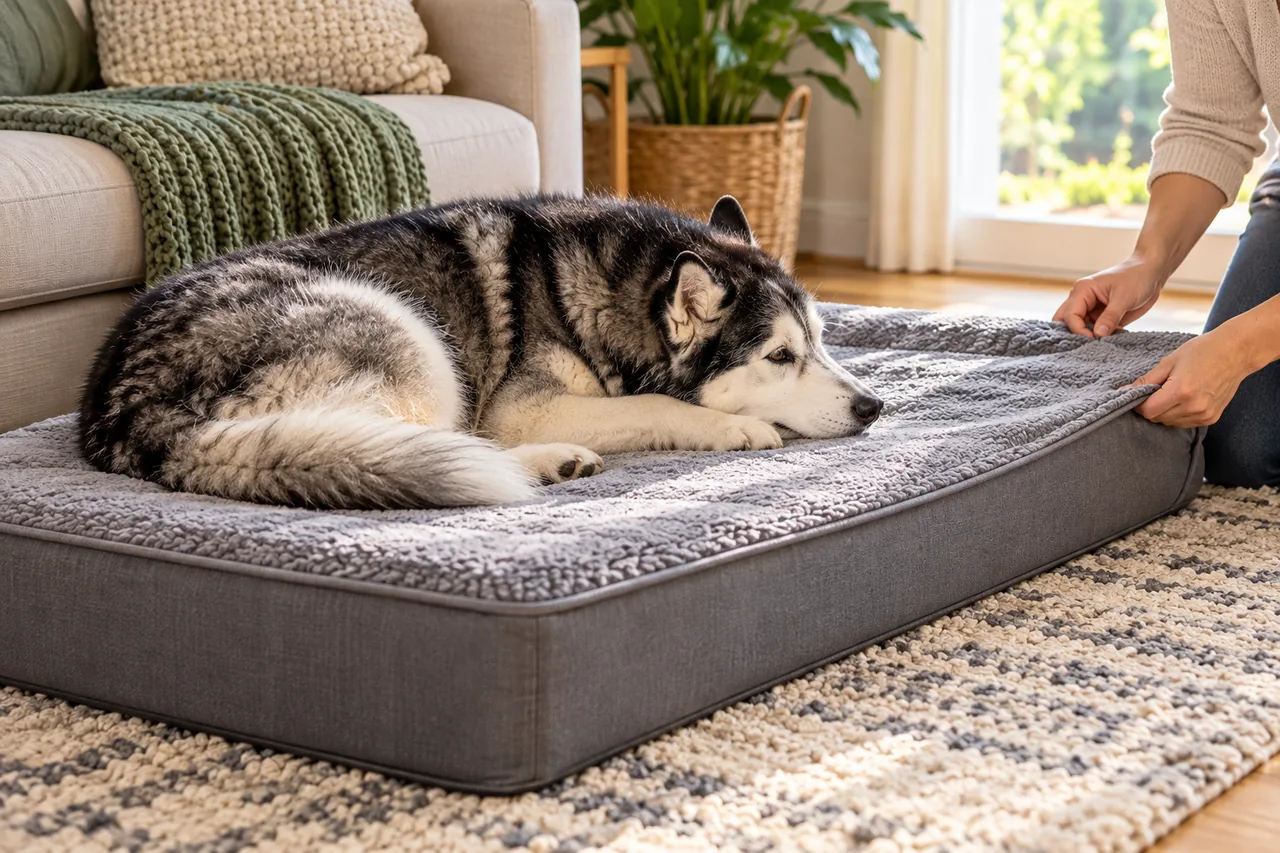
What is a hygroma—and what is it not?
The Merck Veterinary Manual describes a hygroma as a fluid-filled sac that forms over a bony prominence, especially the elbow. Repeated pressure and trauma from lying on hard surfaces can trigger inflammation and the body’s response may create a cushioning-like pocket of fluid. Large and giant-breed dogs are commonly affected, but any dog can develop a problem at a pressure point.
A hygroma is not the same thing as every lump, swelling, scrape, or sore. A bump may have another cause, and an owner cannot reliably identify it from a photograph or touch alone. Hygromas can also become more complicated if inflammation persists or the skin breaks down. That is why new or changing swelling deserves veterinary assessment rather than a trial-and-error bed purchase.
Which dogs need a closer resting-surface check?
Look more carefully at the sleeping environment when a dog spends long periods lying down, has limited ability to get up or turn, has prominent bony points, or has a known mobility condition. Large and giant breeds may be more prone to elbow hygromas, and older dogs with arthritis may rest for longer stretches. These are reasons to pay attention—not proof that a swelling is a hygroma.
During an ordinary grooming or comfort check, look at the elbows and other bony contact areas you can see without forcing the dog into an uncomfortable position. Note any new swelling, redness, hair loss, scabbing, damp fur, odor, discharge, or signs that touching or moving is painful. Do not press repeatedly on a lump to “test” it.
Check the bed as a system, not just a thickness number
1. Use meaningful padding over hard surfaces
Veterinary references such as VCA Animal Hospitals’ hygroma guidance emphasize padding to reduce further trauma. A dog that repeatedly rests on tile, concrete, or bare hardwood needs a comfortable padded option in the places it actually chooses to lie down. A thin throw may bunch or shift and leave the same hard contact underneath.
2. Check support under the dog’s weight
Padding should not be judged only by how plush the bed feels when empty. Watch the bed while your dog lies naturally. Does the sleeping surface still provide a layer between the body and the floor? Does one area collapse dramatically or remain deeply hollow after use? Some compression is normal; a bed that has lost meaningful support deserves a closer look. Our bottom-out support checklist explains how to observe the loaded bed without treating a hand press as a laboratory test.
3. Keep entry and exit manageable
A supportive surface is less useful if a tall edge or unstable bolster makes it hard to reach. Check the real step-over height, approach space, and landing area. The bed should not slide or fold when the dog turns or rises. Compare our bed-height and entry-access guide and non-slip base checks if access or movement is part of the problem.
4. Make the sleeping area easy to keep clean and dry
Choose a setup you can maintain in real life. If bedding becomes damp from urine, drool, water, or a wound dressing, follow the veterinarian’s instructions and the manufacturer’s care label. Change wet layers promptly and let washable components dry fully before refitting them. Our bed-accident cleanup guide separates cleaning the cover from caring for the foam or core.
A simple daily pressure-point routine
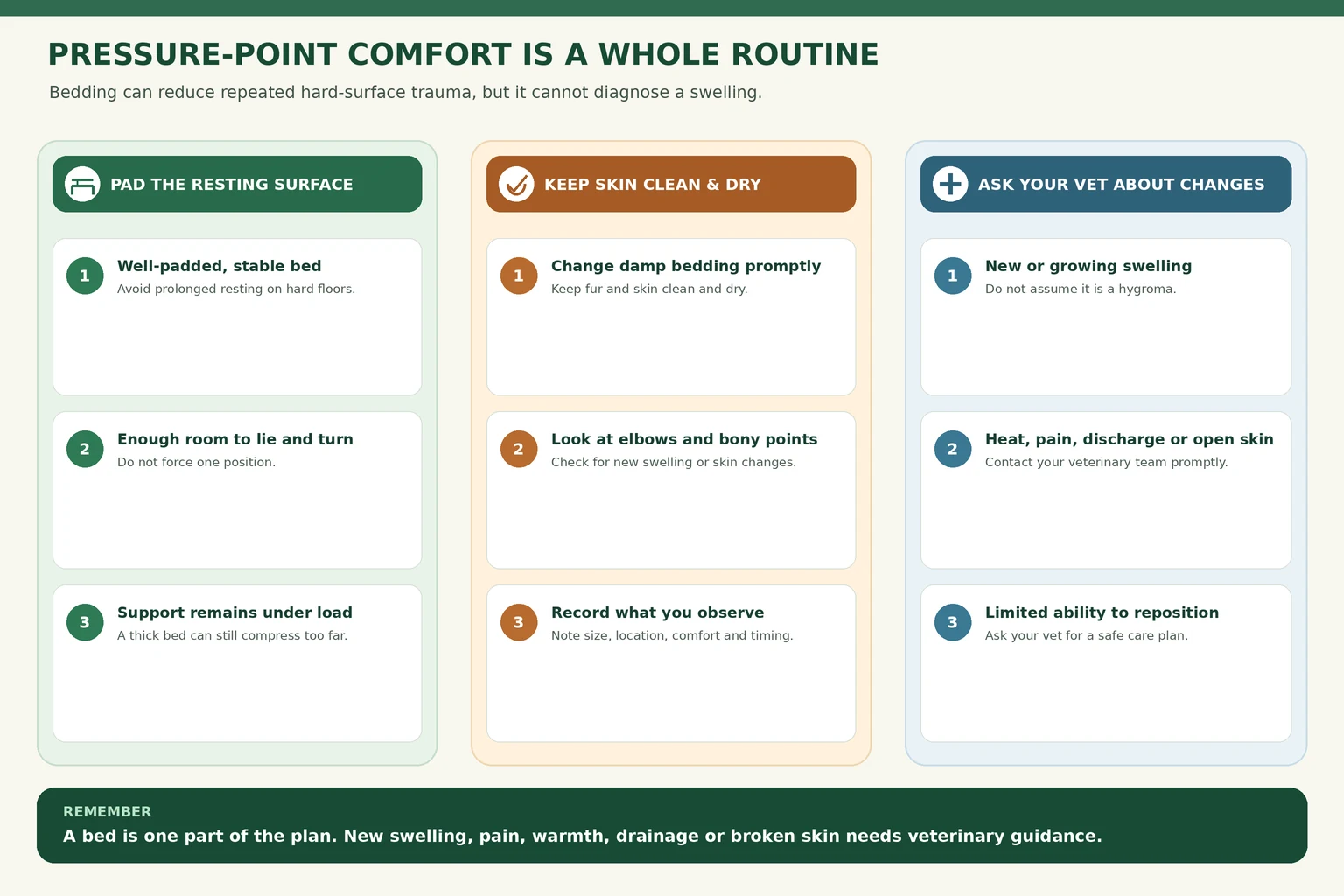
- Check the resting area. Make sure the bed is dry, stable, and still padded where your dog normally lies.
- Observe, don’t force. Notice whether your dog can settle, shift position, and get up without unusual struggle. Do not make a painful dog repeatedly stand for a test.
- Look for visible changes. During routine care, note new swelling, redness, skin damage, damp fur, or discharge without squeezing or massaging the area.
- Keep a short record. Write down the date, location, approximate size, skin appearance, changes in movement, and any discharge or discomfort. A photo from a consistent distance may help your veterinarian compare changes.
- Ask for a care plan if movement is limited. If your dog cannot reposition independently, ask the veterinary team how to manage position changes, bedding, skin checks, and hygiene for that individual dog. Do not assume one schedule fits every patient.
The AAHA senior-care guidance recommends adequately padded bedding, keeping skin and bedding clean and dry, monitoring skin for changes, and discussing additional nursing care when mobility is decreased. The exact plan should match your dog’s health and veterinary instructions.
What not to do at home
- Do not puncture, drain, or try to flatten a swelling.
- Do not apply human creams, disinfectants, heat, or tight wraps unless your veterinarian specifically instructs you to do so.
- Do not massage a painful or newly swollen area to test whether it is fluid-filled.
- Do not assume a thicker or more expensive bed will resolve a skin or joint problem.
- Do not leave a dog who cannot reposition comfortably on a hard floor while waiting for a new product to arrive.
When should you call the veterinarian?
Contact your veterinary team promptly about any new or enlarging swelling over a bony point, especially if it is warm, red, painful, leaking fluid, bleeding, foul-smelling, or accompanied by broken skin. Also call if your dog starts limping, avoids lying down, repeatedly gets up and down, becomes less willing to move, or seems unwell. Those signs may have causes other than a hygroma and need appropriate assessment.
Seek urgent veterinary advice if your dog suddenly cannot stand or walk, has severe pain, significant bleeding, or a rapidly worsening wound. If a hygroma or pressure-related injury is already diagnosed, follow the clinician’s plan for padding, wound care, activity, and rechecks. A bed can support that plan; it cannot replace it.
A short observation log to bring to the appointment
Write down these five things:
- Where the swelling or skin change is located.
- When you first noticed it and whether it seems to be changing.
- Whether the skin is intact, red, damp, open, or draining.
- Which surfaces your dog uses most—bed, rug, tile, hardwood, or concrete.
- Any new difficulty rising, turning, walking, or settling.
Keep the log factual. Avoid labelling the bump yourself; let the veterinarian decide what it is and whether testing or treatment is needed.
Keep exploring
For the broader bed-construction picture, read Anatomy of a True Orthopedic Dog Bed. If you are unsure whether the current mattress still provides support, use the loaded-bed support check. If access is the barrier, review entry height and bed placement.
Evidence limits
Veterinary references describe hygromas, pressure-related tissue changes, and the role of padding and skin care. This article translates that guidance into a home observation checklist; it does not diagnose a swelling, prescribe treatment, or promise that a particular bed prevents or cures a condition. Product descriptions and bed dimensions are listing information, not clinical evidence. If you see a change in the skin or your dog’s comfort, involve your veterinary team.
Common questions
Can a soft dog bed make a hygroma go away?
Do not rely on a bed to make a hygroma disappear. Adequate padding may help reduce repeated hard-surface trauma, but diagnosis and treatment depend on the individual dog and the condition of the swelling. Ask your veterinarian what changes to make and how to monitor it.
Are elbow hygromas only a problem for giant breeds?
No. They are often described in large and giant breeds, but repeated pressure or trauma can affect other dogs too. A new elbow lump should not be labelled a hygroma without veterinary assessment.
Should I use a human mattress topper or folded blanket?
Not automatically. A loose topper or folded blanket can bunch, slide, trap moisture, or create an awkward edge. Use a stable, appropriately padded surface that your dog can access safely, and ask your veterinarian about a setup for a diagnosed hygroma or wound.
How often should I reposition a dog that cannot move well?
There is no single schedule suitable for every dog. Ask the veterinary team for an individualized plan based on mobility, skin condition, pain, and other health needs. Do not force movement that causes pain or distress.
Is every elbow swelling a hygroma?
No. Other conditions can cause lumps or swelling. Avoid squeezing or draining the area; have a veterinarian examine it, particularly if it is new, growing, painful, warm, leaking, or the skin is damaged.
Sources & veterinary context
- Merck Veterinary Manual — Hygromas in Dogs
- VCA Animal Hospitals — Hygroma in Dogs
- American Animal Hospital Association — Home Tips for Clients Caring for Senior Pets
- AAHA — 2023 Senior Care Guidelines for Dogs and Cats
Source review: October 11, 2026. Veterinary sources support the role of padding, cleanliness, skin monitoring, and individualized care. They do not support diagnosing a hygroma from an owner’s photo or promising that a specific commercial bed will prevent or cure one.