

A bed can look plush and supportive but still be difficult to enter or leave. For an older dog, the practical question is not simply whether a bed is raised or low: it is whether the dog can approach, step onto it, turn, lie down, and stand up without struggling or slipping.
Start with a calm observation
Watch the approach, entry, settling, and exit separately. Do not coax your dog into a jump or change several things at once; make one safe adjustment and observe.
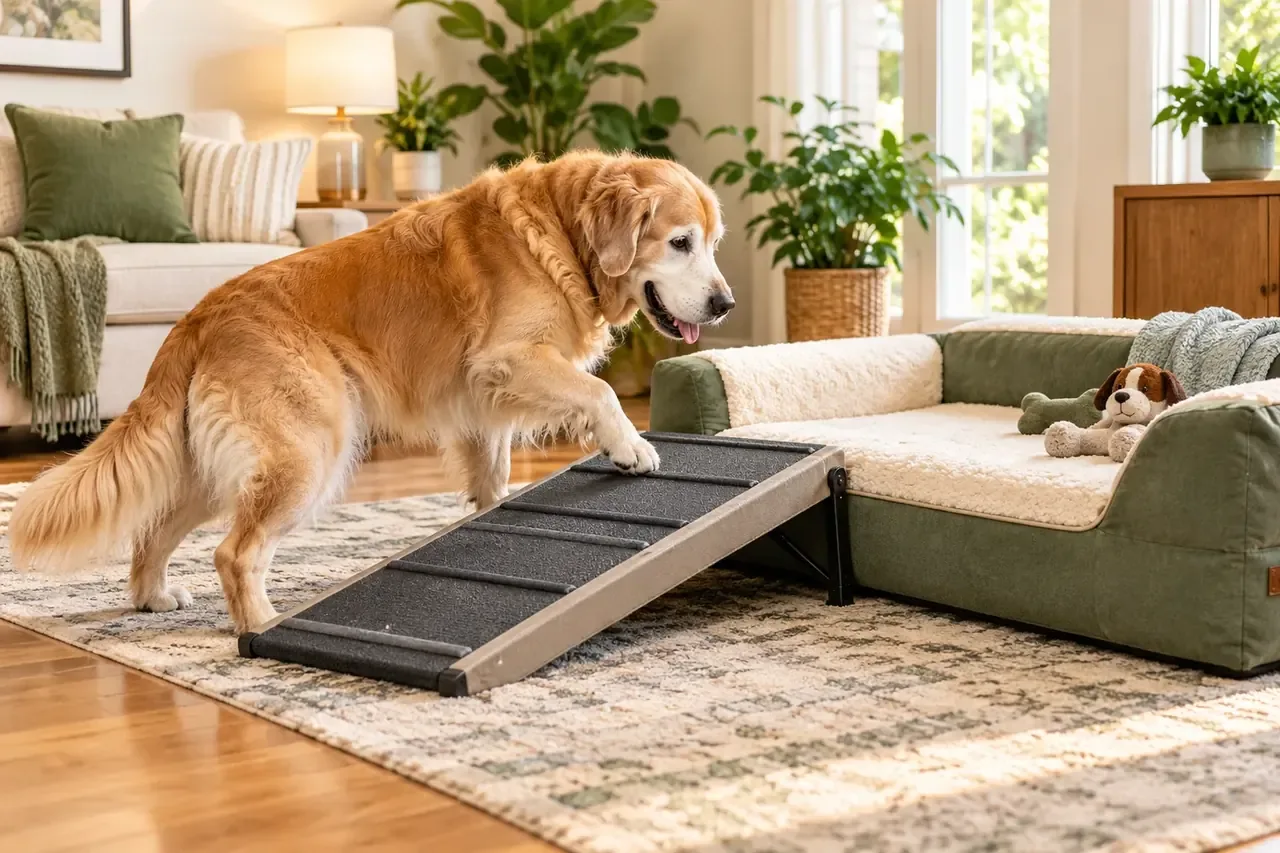
Measure the actual step-over
Measure from the floor to the top of the sleeping surface at the edge your dog will use. Include any raised rim or bolster that blocks the easiest route. Record the height rather than relying on a product name such as “low entry.”
Measure the edge your dog actually uses, including a raised rim or bolster that blocks the easiest route; the advertised frame height alone can be misleading.
Watch the approach
Observe your dog walking toward the bed naturally. Hesitation, repeated repositioning, pawing at the edge, or choosing the floor may mean the entry is awkward. Do not repeatedly coax a dog to jump to prove a point.
Repeated circling, pawing at the edge, changing direction, or choosing the floor are useful observations, but they do not prove height is the cause. Also consider pain, noise, temperature, location, and confidence.
Check the landing and takeoff area
The floor beside the bed should provide enough room for a steady approach and a turn. Move clutter, loose blankets, and sliding mats that could shift under the paws.
Check both sides of the bed. Loose rugs, sliding mats, clutter, or a narrow approach can make a suitable bed difficult to use.
Test bed stability
Press the edge gently and check whether the bed slides, tips, or compresses unevenly. A moving bed can make an otherwise manageable step feel less predictable.
A bed that slides, tips, or compresses unevenly can make a manageable step feel unsafe. Improve stability before assuming the bed height itself is wrong.
Look at the whole transition
Entry is only half the task. Notice whether your dog can turn around, settle, and rise from the surface. A high bolster may support some dogs once lying down but obstruct others during entry or exit.
Watch turning, settling, repositioning, and getting down—not entry alone. A high bolster may support some dogs after they lie down but obstruct another dog at the edge.
Avoid a one-size-fits-all height rule
There is no single bed height that suits every senior dog. Body size, limb length, mobility, pain, confidence, and the surrounding floor all affect the task. Compare the bed with your dog’s observed movement, not an unsupported universal number.
Know when to ask for help
A new reluctance to climb, repeated slipping, yelping, weakness, or difficulty rising deserves veterinary advice. Do not assume a bed alone explains a sudden mobility change.
Seven signs the current setup may be difficult
- Your dog pauses, circles, or changes direction at the bed edge.
- A thick mattress edge or bolster blocks the easiest entry point.
- The bed shifts or tips when your dog steps on or pushes up.
- Your dog struggles to turn, settle, or reposition after entry.
- Getting down looks harder than getting onto the bed.
- The surrounding floor, loose rugs, or clutter interrupt safe footing.
- A sudden change in movement appears alongside pain, weakness, or repeated falls.
Quick checklist
- Top sleeping-surface height measured
- Lowest usable entry point identified
- Stable, nonslip approach area
- Enough room to turn and exit
- Dog observed without being forced to jump
- Changes in movement discussed with a veterinarian when needed
Related Senior Dog Comfort guides
When to contact your veterinarian
Seek veterinary advice for new or worsening difficulty standing, walking, climbing, repeated slipping, apparent pain, weakness, or falls. Sudden severe weakness or inability to stand warrants urgent veterinary care. This guide is educational and is not a diagnosis.