


treat “non-slip,” “anti-skid,” and “non-skid” as starting claims—not guarantees. The useful question is whether the complete assembled bed stays flat and resists movement on your clean, dry floor when the entry edge is loaded.
Our synthesis: think of the bottom like shoe tread. Tread can help, but performance still depends on the material, the surface beneath it, contamination between the two, and the direction and force of movement.
What “anti-skid” does—and does not—prove
A listing can tell you that a bed has a grippy-looking base. It usually does not tell you how much of that base actually touches the floor, what residential surfaces were tested, whether the cover still lies flat after washing, or how the bed behaves when a dog steps onto one edge.
For a senior dog, that transfer moment deserves attention. Cornell’s canine osteoarthritis guidance lists difficulty getting up among common signs and includes non-slip rugs as a home-management option. That veterinary context supports reducing avoidable sliding; it does not prove that a particular bed bottom will work on every floor.
Seven checks before you trust a non-slip dog-bed bottom
1. Find the actual base material—not just the badge
Look for a close-up underside photo and a specific material description. Common designs include rubberized dots, textured woven panels, silicone-style printing, or a separate grippy layer. “Anti-skid bottom” without a material, image, or floor-compatibility note is a feature claim, not a performance measurement.
Listing verified: the current Chewy listing for the PetFusion Ultimate Lounge documents construction details such as its liner and removable cover, while an independent hands-on review describes a no-skid bottom. That difference is useful: important base details can be easier to find in one source than another, so verify the exact current variant rather than assuming every size or cover is identical.
2. Check how much of the underside can actually touch the floor
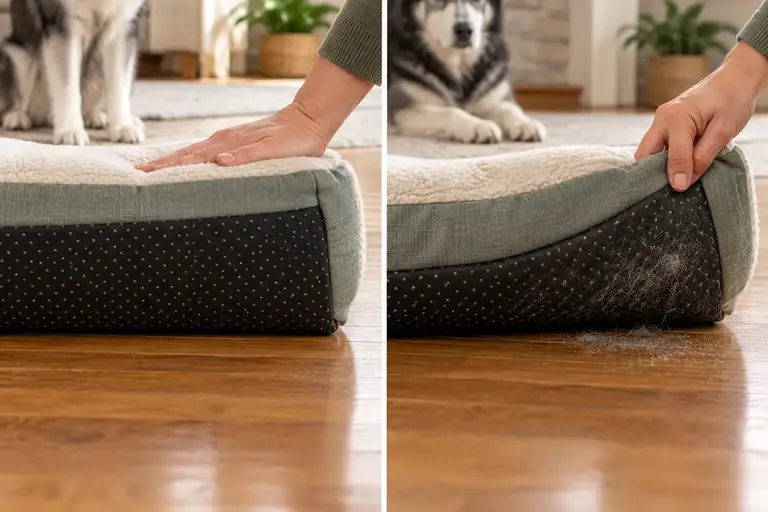
A full textured panel has more potential contact area than a few small patches—but only if it lies flat. Turn the assembled bed over in product photos or after delivery and look for exposed zippers, thick seams, bunched inserts, bowed centers, curled corners, or a cover that fits too loosely.
The useful field is usable grip area, not just total bed dimensions. If the base touches only around the perimeter, the center cannot contribute much friction.
3. Pair the base with the actual floor
A base that behaves well on unfinished tile may act differently on polished hardwood, luxury vinyl, laminate, or a low-pile rug. Do not treat “hard floors” as one material.
Check your flooring maker’s care and warranty instructions before adding a separate rubber, latex, adhesive, or colored pad. If bed and floor guidance conflict, protect the floor and choose a compatible barrier rather than improvising.
Our synthesis: bed stability is a system property: bed base + floor finish + cleanliness + load + direction of force. A listing usually describes only the first part.
4. Inspect the cover fit after washing
The underside can start flat and become less effective if a cover stretches, shrinks, twists, or is reinstalled off-center. Follow the maker’s wash and drying directions. After every wash, seat the foam or liner fully into the corners, smooth wrinkles outward, close and tuck the zipper as designed, and confirm that the assembled bed lies flat.
If the grippy panel is sewn into the removable cover, also check whether a replacement cover includes the same base construction.
5. Remove the invisible “ball bearings”
Hair, dust, sand, and dried cleaning residue can sit between the bed and floor. Even a textured base cannot grip the flooring directly if debris separates the surfaces.
Vacuum or wipe the floor and clean the underside according to its care label, then let both dry fully before retesting. The goal is not to make the base tacky with household products; unapproved sprays can leave residue, damage materials, or affect floor finishes.
Independent context: a hands-on PetFusion review reported that the no-skid cover stayed in place better than beds the reviewer had used previously. That is useful real-home context, but it is one bed, one home, and one floor—not a universal result.
6. Test the entry edge—not only the center
Pressing straight down in the middle can make almost any heavy bed feel stable. A dog often loads the bed differently: one paw reaches the entry edge, body weight moves forward, and the bed may receive a sideways push during a turn or stand-up.
The 60-second bed-slide test
- Place two small paper markers immediately beside two bed corners. Do not tape the bed or floor.
- Press down and forward on the intended entry edge with one hand—firmly, but not with a shove.
- Press sideways on the same edge to mimic a turn.
- Press down near the exit edge and release.
- Compare the corners with the markers. Any repeatable movement, corner lift, bunching, or delayed return means the setup needs correction.
This is a practical screening test, not a certified slip-resistance measurement. Repeat it after washing, moving the bed, or changing the flooring beneath it. Do not pull your dog onto a setup that has already failed the empty-bed check.
7. Plan the backup before relying on it
If the bed moves, first correct assembly and cleanliness. If it still moves, consider a floor-compatible, low-profile pad slightly smaller than the bed so no edge becomes a new trip point. It should lie flat, stay dry, and remain removable for cleaning and floor inspection.
Also check whether the brand sells replacement covers with the original underside. A replaceable base layer is more useful than a permanent claim that disappears when the cover wears out.
Do not use an improvised fix that creates a raised lip, exposed adhesive, loose corner, or chewable layer. If your dog suddenly slips more often, struggles to rise, changes gait, or avoids the bed, contact your veterinarian; a bed adjustment is not a diagnosis or treatment.
Bed-base comparison fields
| Field to compare | Stronger evidence | Weak evidence |
|---|---|---|
| Base construction | Material plus a close-up underside photo | “Non-slip” badge only |
| Contact area | Full base lies flat when assembled | Small patches or curled corners |
| Floor pairing | Named compatible surfaces and care notes | “Works everywhere” language |
| After washing | Cover refits tightly; instructions are specific | No reinstall or drying guidance |
| Maintenance | Base can be cleaned without added coatings | Household tack sprays suggested |
| Serviceability | Replacement cover retains the grip panel | Replacement base unspecified |
| Real-world check | Passes the entry-edge test in the final location | Feels stable only when pressed in the center |
How we separate the evidence
Listing verifiedRetail listings can document bed construction, cover, liner, foam and an anti-skid or non-skid feature. They rarely publish a standardized coefficient of friction for the assembled bed across multiple residential floors.
Independent contextIndividual reviewers can reveal whether a bed moved in a particular home. Those observations are useful for generating questions, not for guaranteeing performance in another room.
Hands-on with CooperNo controlled Cooper test is reported for this article. The 60-second procedure is provided so each reader can test the exact bed/floor pairing at home without presenting an unperformed test as evidence.
Veterinary contextCornell recommends non-slip rugs as one lifestyle modification for dogs with osteoarthritis and notes that affected dogs may have difficulty getting up. This supports improving traction around rest areas without turning a bed-base claim into a medical conclusion.
Our synthesis: the label is the start of the evaluation. The assembled bed must stay flat and resist edge loading on the reader’s actual, clean, dry floor.
Bottom line
For a senior dog, “anti-skid” should be verified at the entry and exit edges, not accepted from a badge on the listing. Choose a clearly described base, confirm full contact, preserve the fit after washing, keep both surfaces clean, and repeat a gentle slide test in the final location. If the bed still moves, add only a floor-compatible low-profile solution—or choose a different bed.
Then connect the bed to the rest of the setup: use the route-first hardwood traction guide, compare the true entry/step-over design, check usable sleep area, and evaluate support and bottom-out separately.
Common questions
Is a heavier dog bed automatically less likely to slide?
Not automatically. Weight may help resist movement, but a smooth or contaminated base can still shift—especially when force is applied at one edge. Test the assembled bed on the actual floor.
Can I put any rubber mat under a dog bed?
No. Check the flooring manufacturer’s care and warranty instructions and the mat maker’s compatibility information first. Keep the pad low-profile, fully under the bed, dry, and inaccessible to chewing.
How often should I repeat the slide test?
Repeat it after laundering or reinstalling the cover, moving the bed, changing the floor or pad, or noticing new movement. A quick monthly check is reasonable for a frequently used bed, but observation should guide the schedule.
Related traction check: The bed base is only one contact point. For the first steps after the bed, use the non-slip rug and runner checklist to evaluate the floor route around it.
Sources & evidence limits
Cornell University College of Veterinary Medicine — Osteoarthritis: veterinary context for difficulty getting up and non-slip rugs as a lifestyle modification; reviewed September 23, 2026. Chewy — PetFusion Ultimate Lounge Memory Foam Bolster Bed: current retailer construction details reviewed September 23, 2026. Dog Gear Review — PetFusion Ultimate Dog Lounge Review: independent household observation of the no-skid cover; anecdotal and not generalized.
Manufacturer and retailer descriptions, product variants, prices and availability can change. This article is a buying and home-observation guide, not a certified friction test, diagnosis, or treatment recommendation.
View bed options to inspect with this checklist
These are shopping options to inspect—not anti-skid winners. Verify the exact selected size, underside construction, cover fit, floor pairing and current retailer details before ordering.
These are affiliate links. Senior Dog Comfort may earn a commission from qualifying purchases at no additional cost to you.


Product photos are shown for recognition. Packaging, price, stock and exact construction can change; verify the current retailer page and selected variant before purchasing.