💡 Cooper analogy: an armchair and an open mat can both be comfortable
An armchair gives you something to lean against. An open mat gives you more freedom to stretch and turn. Dog-bed shapes work the same way: the useful question is not which shape sounds more orthopedic, but which shape your dog can enter, use, reposition on, and leave comfortably.
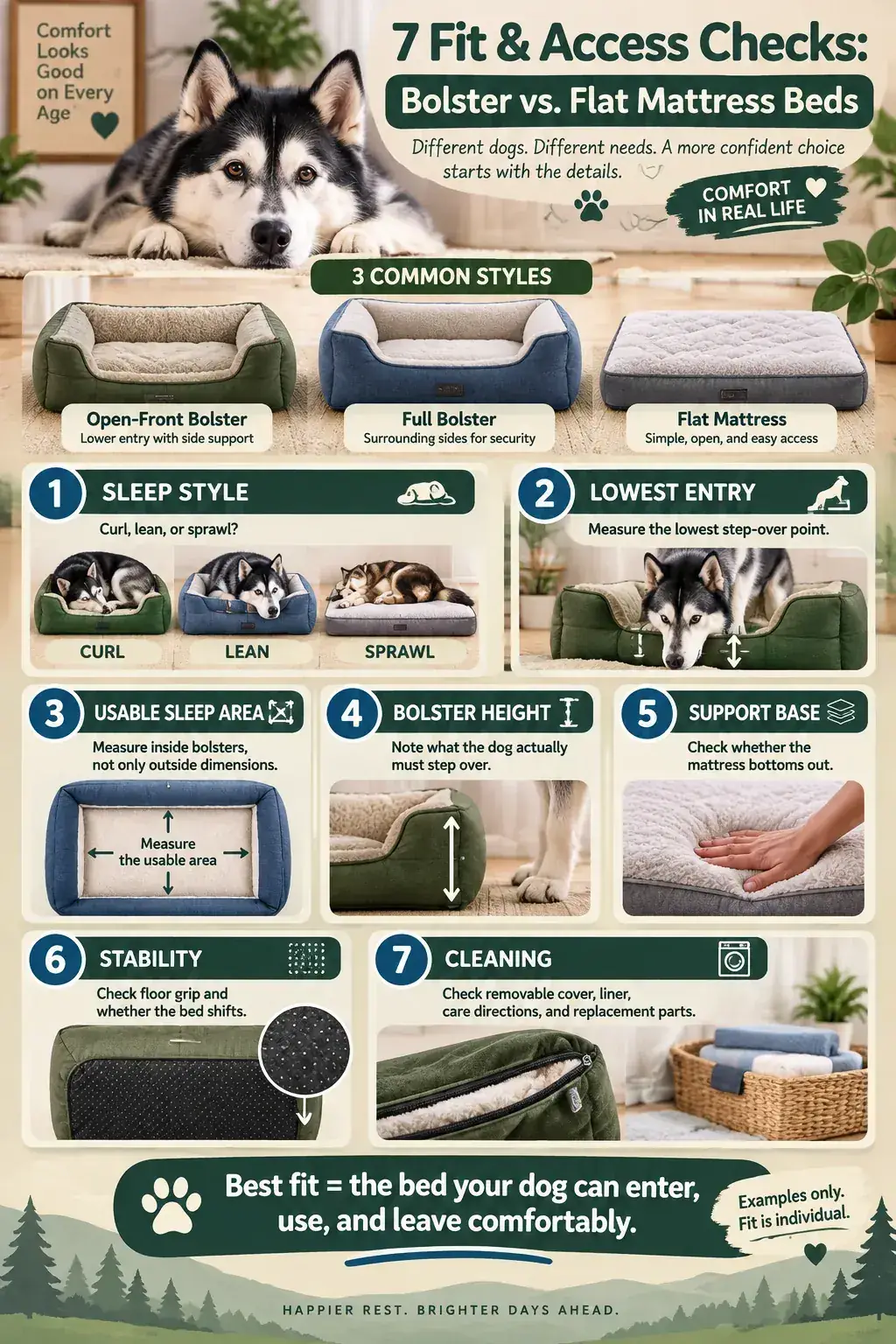
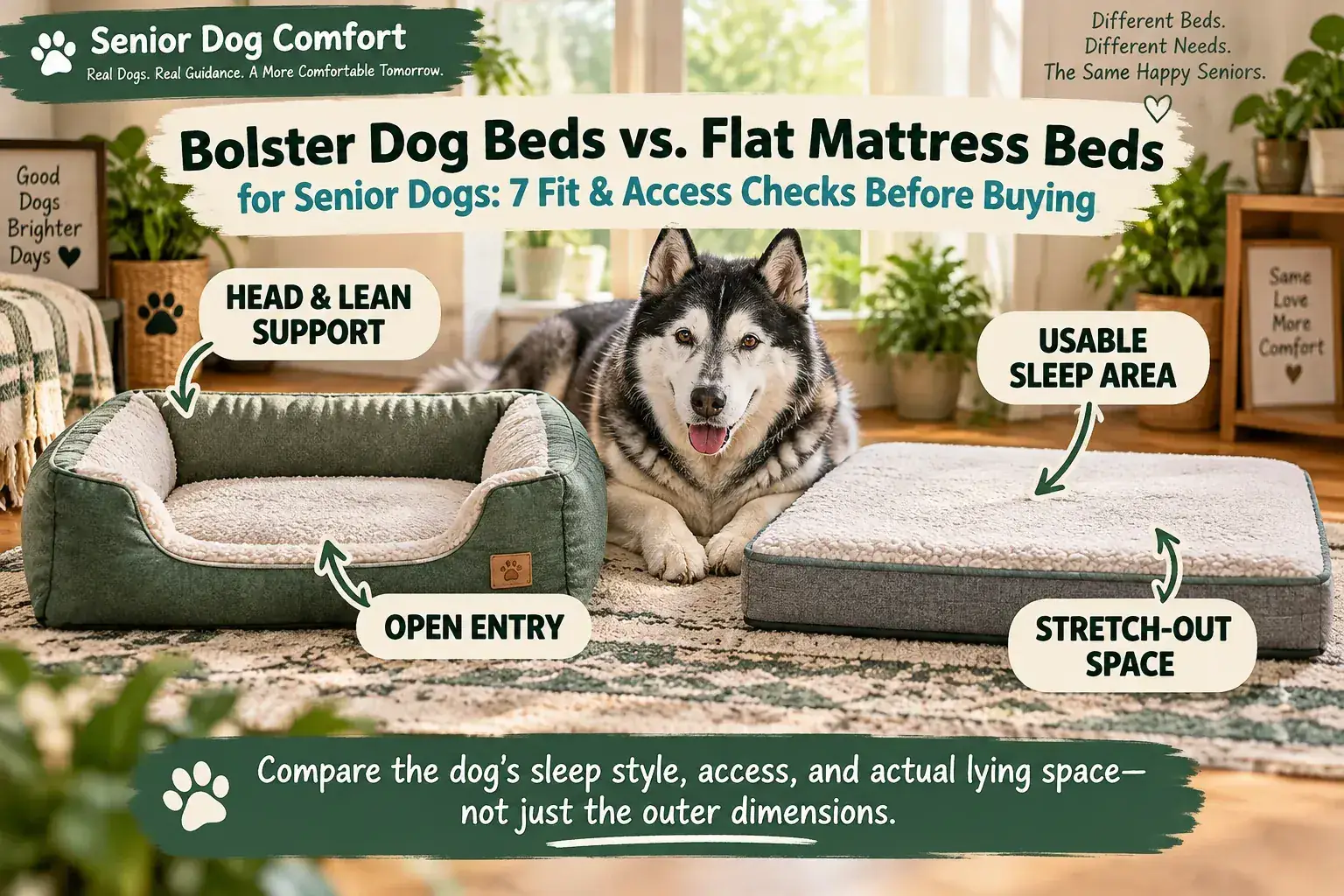
a bolster bed can be a good fit for a dog that likes to curl, lean, or rest the head against an edge—especially when the front is open and easy to step into. A flat mattress can make it simpler to sprawl, approach from any side, and use more of the bed’s footprint as sleeping space. Neither shape is automatically better for every senior dog.
PetMD’s 2026 veterinarian-reviewed orthopedic-bed guide makes the same practical distinction: dogs that stretch may prefer no sides, while dogs that curl or prop themselves up may prefer plush edges. It also notes that four-sided bolsters can be harder to enter for some dogs with joint problems, while three-sided designs can preserve an easier entry. That is useful context—not a universal height rule.
1. Start with the way your dog actually sleeps
Watch several normal naps before shopping. Does your dog curl tightly, lean the back or head against something, or stretch out long and change positions often? A dog that regularly uses a wall or sofa edge as a headrest may appreciate a bolster. A sprawler may value open surface area more.
Do not infer comfort from one staged photo. Use repeated, voluntary behavior. Our Cooper’s Comfort Check uses the same principle: observe what the dog chooses rather than turning a home observation into a medical score.
2. Measure the lowest entry point—not the tallest wall
For an open-front bolster, record the lowest edge your dog must actually step over. For a flat mattress, record the mattress height from the floor. A full bolster may have a much higher side wall than the front edge of an open-front model, so the product’s total height is not the same thing as the dog’s entry height.
There is no single medically correct entry height for every senior dog. Compare the bed with what your dog comfortably manages now, and use our low-entry checklist when access is the main concern.
3. Compare usable sleep area with the outside dimensions
Bolsters occupy part of the footprint. That matters when product pages advertise only the outside size. Current manufacturer listings show why the interior measurement deserves its own line on your checklist.
| Listing example | Full bed size | Sleeping surface | Design note |
|---|---|---|---|
| Orvis Memory Foam Couch Dog Bed — Large | 46 × 33 in. | 30 × 23 in. | Three-sided bolster with one open side. |
| K9 Ballistics Tough Bolster Orthopedic Dog Bed — Large | 40 × 34 × 10 in. | 32 × 30 × 5 in. | Manufacturer lists footprint and sleeping surface separately. |
These are examples, not rankings. Different brands and sizes use space differently. If the interior dimensions are missing, ask for them instead of assuming the full footprint is usable. You can also use our Senior Dog Bed Size Planner to turn your dog’s resting measurements into an interior-space target.
4. Check what the bolster does at the entry and while turning
A bolster can give a dog something to lean against, but the same side wall can also narrow the turn-in space or create a step-over point. Look at the actual open side, the width of that opening, and whether your dog can approach without squeezing between furniture or another obstacle.
Our easy-entry and stable-access guide separates the lowest entry edge from total bed height and explains why the route to the bed matters too.
5. Judge the mattress underneath the bolster
A raised edge does not tell you whether the sleeping surface is supportive. Press where the hips and shoulders would rest and check whether the mattress collapses to the hard floor or base. Compare the foam layers, thickness, support core, and what happens under load.
For a flat mattress, make the same check. Shape and support are separate decisions. A thick bolster bed can still have a weak base, and a low flat bed can still have a strong supportive core.
6. Check the bed when the dog gets on and off
Push near the entry edge and corners. Does the bed slide on the actual floor, twist, rock, or bunch up? A low entry loses much of its advantage if the whole bed moves when the dog transfers weight.
Check the floor underneath too. A non-slip base, rug, or stable placement can matter as much as the shape of the bed itself.
7. Compare cleaning and replacement parts
Bolster beds often have more pieces: outer cover, bolster inserts, mattress core, and sometimes a separate liner. Flat mattresses may be simpler, but the same questions still apply. What removes? What is machine washable? What must air-dry? Is the foam protected? Can you buy a replacement cover or liner?
If accidents are part of the routine, our waterproof bed vs. liner guide shows why “waterproof” can refer to different layers.
A simple shape decision
- Likes to curl or lean: compare an open-front or three-sided bolster first.
- Likes to sprawl or change positions: compare a flat mattress or a very open bolster design.
- Entry is difficult: measure the lowest step-over and watch the approach, not just the side-wall height.
- Large dog: verify interior sleeping dimensions; do not buy from the outside footprint alone.
- Bed slides: solve floor grip and bed stability before treating shape as the only problem.
- Frequent cleanup: prioritize removable washable parts and foam protection.
Common questions
Are bolster beds better for senior dogs?
Not universally. Some dogs like the leaning or head-resting surface, while others need a more open route or more room to stretch. Fit, entry, support and the dog’s own sleep style matter more than the label.
Do flat beds always have easier access?
They remove raised side walls, but mattress thickness, floor traction and surrounding space still affect entry. Compare the actual height and route your dog uses.
Should I size up when a bed has bolsters?
Sometimes. The useful comparison is your dog’s relaxed resting dimensions versus the listed interior sleeping surface. If the manufacturer gives only exterior dimensions, ask for the interior measurements before buying.
Sources and evidence limits
- PetMD — 5 Best Orthopedic Dog Beds of 2026, Recommended by Vets: veterinarian-reviewed context on stretchers, curlers, bolsters and easier-access three-sided designs.
- Orvis Memory Foam Orthopedic Couch Dog Bed: current full-bed and sleeping-surface dimensions plus three-sided/open-side design description.
- K9 Ballistics Tough Bolster Orthopedic Dog Bed: current footprint, sleeping-surface and mattress-height specifications.
- American Kennel Club — Making Your Home More Accessible for Your Senior Dog: general senior-dog mobility and home-accessibility context.
Source review: September 17, 2026. Manufacturer specifications can change. The product examples are used to show how outer and sleeping dimensions can differ; they are not endorsements or independent Senior Dog Comfort tests. See how we evaluate evidence.
View supportive dog-bed options
Use the seven checks above on the exact size and style you open. Compare the lowest entry, interior sleeping area, mattress support and care details before ordering.
These are affiliate links. Senior Dog Comfort may earn a commission from qualifying purchases at no additional cost to you.