

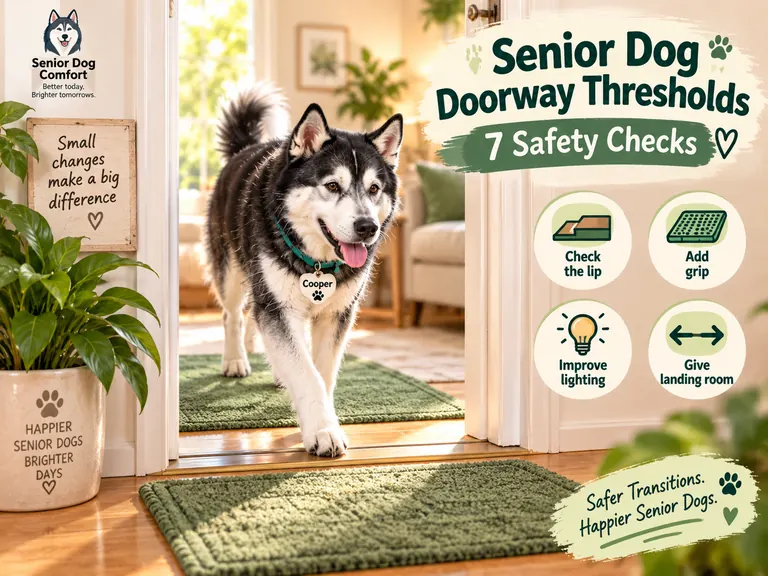
Think of a doorway like a tiny bridge
A doorway is a short transition between two familiar spaces. For a senior dog, the challenge may be the lip underfoot, the change in traction, the turn immediately after it, or the need to step through while the door is moving. Make the crossing predictable and give the paws a secure landing on both sides.
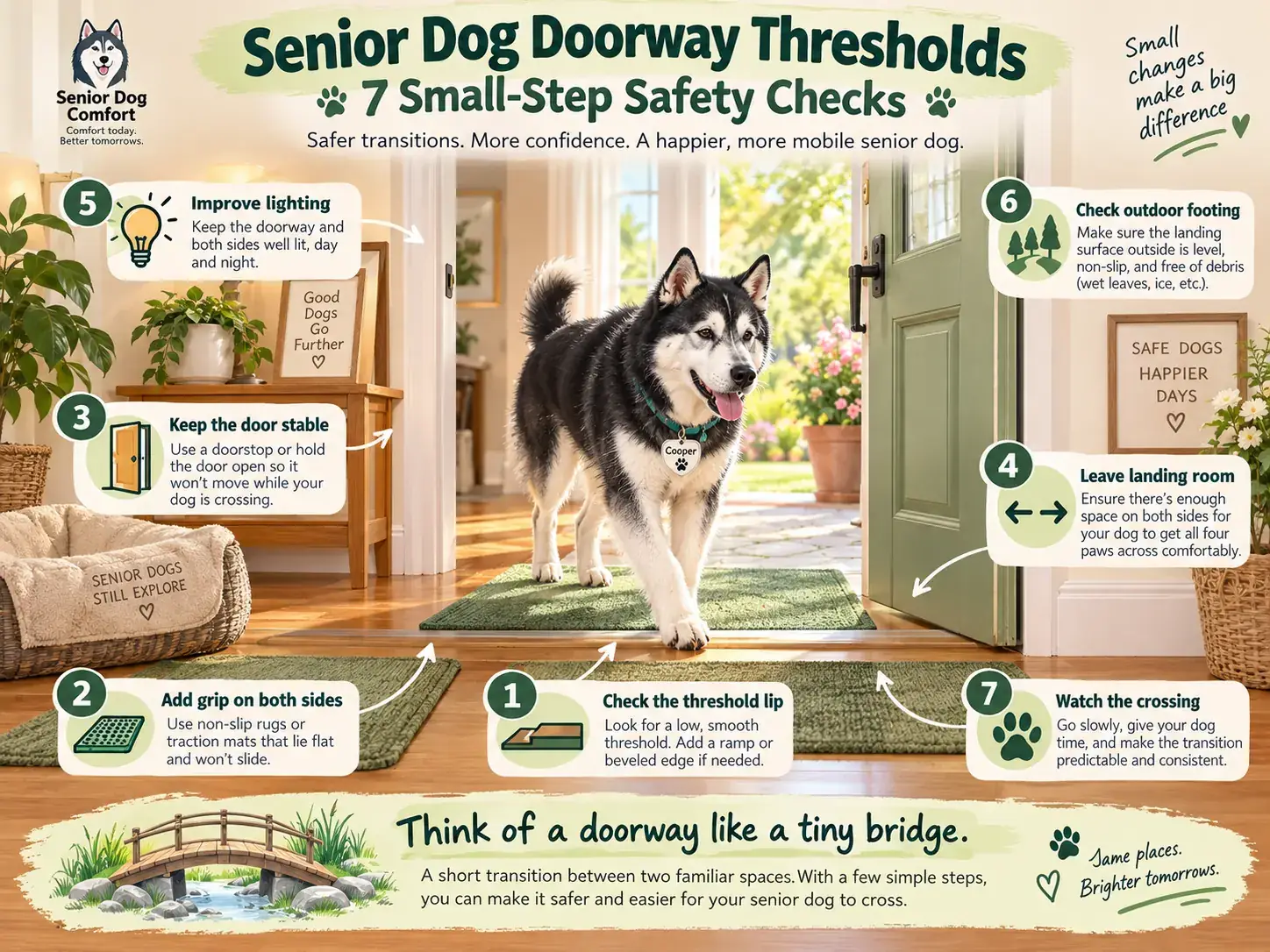
Doorways can concentrate several mobility challenges into a very small area. A senior dog may need to clear a lip, keep balance while the surface changes, avoid a swinging door, and find enough room for all four paws before turning. The goal is not to make every doorway identical. It is to remove avoidable surprises and make the route easier to read.
1. Check the threshold lip
Look at the exact step-over point from your dog's eye and paw level. A low threshold can still feel awkward if it is sharp-edged, uneven, loose, or paired with a slick floor. Watch whether your dog clips a toe, pauses before stepping, lifts the paws unusually high, or tries to jump the transition. If a permanent threshold is difficult, a securely fitted beveled transition or appropriately designed low ramp may be easier than asking the dog to keep negotiating an abrupt edge.
2. Add grip on both sides
Traction should begin before the threshold and continue far enough beyond it for the dog to finish the crossing. A tiny mat that ends under the front paws may leave the rear paws on slick flooring at the hardest moment. Use flat, secure surfaces that do not bunch, curl, or slide. For a broader route-first setup, see our senior dog hardwood-floor traction guide.
3. Keep the door stable while your dog crosses
A moving door changes the size and shape of the opening while the dog is already committed to the step. Hold the door securely or use a safe doorstop when appropriate so it cannot drift, swing, or bump the dog. Check handles, closers, screens, and exterior doors that may move with wind. The crossing should stay the same from the first paw through the last.
4. Leave enough landing and turning room
Give the dog space to get all four paws through the opening before asking for a tight turn. Remove clutter, baskets, shoes, bowls, or furniture that force an immediate pivot. If the next movement is a turn, extend the grippy surface through that turn rather than ending it exactly at the doorway.
5. Improve useful lighting
Keep the threshold and both landing areas easy to see, especially at night or in hallways where light changes abruptly between rooms. Avoid strong glare on shiny flooring when possible. Dogs with hearing or vision changes may benefit from even more predictable room layouts and lighting; our hearing and vision home-safety checks cover those adjustments in more detail.
6. Check the outdoor landing too
For exterior doors, inspect the first few steps outside as carefully as the indoor side. Wet leaves, ice, loose gravel, uneven pavers, mud, a steep drop, or a slippery deck can turn a familiar doorway into a difficult transition. Keep the landing clear and stable, and make sure the dog has enough room to stand before moving on.
7. Watch the crossing instead of rushing it
Give the dog time to approach, place the paws, and complete the transition at a comfortable pace. Repeated hesitation, toe-catching, scuffing, new weakness, or a sudden change in how the dog uses a familiar doorway can be useful information to record. A short phone video can also help you show your veterinarian what the movement looks like at home.
Quick doorway check
- Is the threshold lip low, smooth, stable, and easy to see?
- Does traction cover the approach and the landing?
- Will the door stay fully open while the dog crosses?
- Is there room for all four paws before a turn?
- Is the transition well lit without confusing glare?
- Is the outdoor landing level, clear, and non-slip?
- Can the dog cross slowly without being hurried?
Related Senior Dog Comfort guides
- Senior Dog Slipping on Hardwood? Start With the Route, Not a Gadget
- Easy Entry and Stable Access for Senior Dogs
- Support Harnesses and Traction for Senior Dogs
- Dog Ramp Safety for Senior Dogs: 7 Things to Check Before You Buy
Educational home-safety guidance only. Adapt the setup to your dog's individual mobility, vision, flooring, doorway design, and veterinary recommendations.
Related traction check: If a runner will cross or approach the doorway, pair this threshold check with our non-slip rug and runner buying checklist so the edge, backing, and transition work together.