

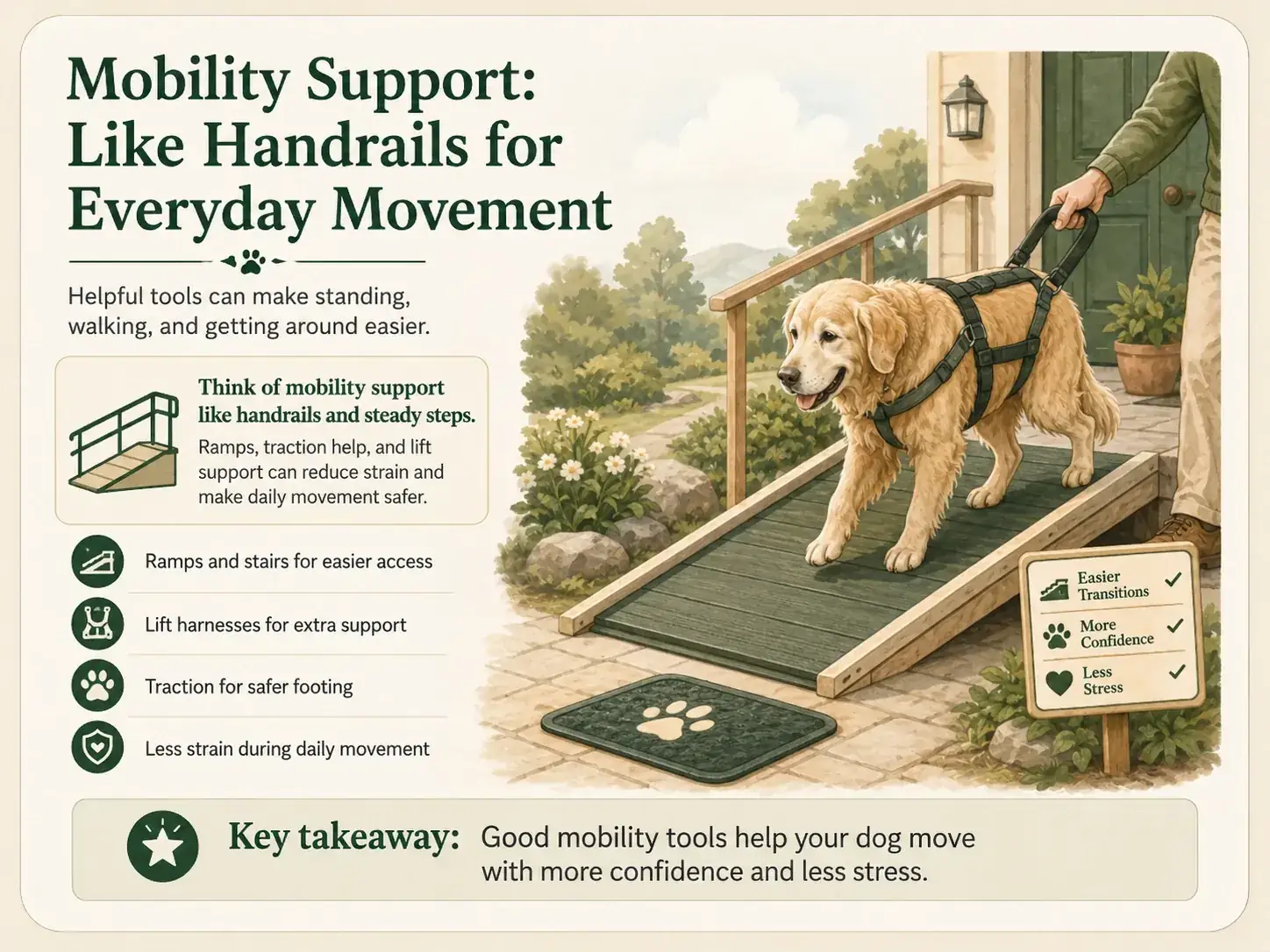
For an older dog, the safest ramp is not automatically the longest, thickest, or most expensive model. What matters is whether your dog can approach it confidently, keep their footing, travel up or down without a sudden wobble, and step off onto a secure landing.
1. Start with the angle, not the product label
Using a ramp at a vehicle? Vehicle entry height, available ground space, attachment points, and safe landings introduce extra fit checks. See our Dog Car Ramps for Senior Dogs guide for the vehicle-specific walkthrough.
The same ramp can feel easy at one height and steep at another. Before buying, think about the actual rise you need to reach: a sofa, bed, porch, SUV cargo area, or another surface. A longer usable ramp generally allows a gentler incline at the same height, while a short ramp placed against a tall surface can create a much more demanding climb.
If your dog already hesitates on stairs or has trouble controlling a descent, treat incline as one of the first comparison points rather than something to check after purchase.
Measure this setup: if you know the landing height and available floor space, calculate the ramp’s geometric length and angle before comparing product labels.
Open the ramp geometry planner →2. Look closely at traction
A ramp surface should help paws maintain grip through the entire path. Smooth plastic, worn fabric, or a surface that becomes slick when damp can change how secure the ramp feels. Look for a traction material that stays attached, covers the usable walking area, and can be cleaned without becoming loose or polished over time.
Also check the floor beneath the ramp. A grippy walking surface does not help much if the base can slide across tile, laminate, or a driveway when your dog steps onto it.
3. Compare usable width with your dog’s natural path
Published width can include outer rails or frame material, so focus on the actual walking surface. A dog that turns slightly, places rear paws wider than front paws, or becomes less precise with age may benefit from extra side-to-side room.
Watch your dog walk through a hallway or across a rug. Their natural paw path can give you a better sense of comfortable width than breed size alone.
4. Test stability at the top, bottom, and center
A ramp should feel predictable before the dog is asked to trust it. Check whether the upper attachment or lip stays seated against the destination, whether the lower end stays planted, and whether the middle flexes or bounces under load.
Small movement that seems harmless to us can make a cautious senior dog stop halfway or refuse the ramp later. Stability is especially important when the dog cannot easily correct a misstep.
5. Check side edges without creating a new obstacle
Raised edges can give visual and physical guidance, but very tall rails or narrow channels can also make a ramp feel confined. The goal is a clear walking path with enough edge definition to help the dog stay centered without forcing an awkward gait.
6. Plan the landing before you set up the ramp
The top and bottom need enough room for your dog to approach, straighten their body, and step off without immediately turning on a slippery surface. A technically good ramp can become difficult when it ends against a wall, furniture leg, door opening, loose mat, or tight vehicle corner.
Think of the ramp as one part of a route. The floor before it and the landing after it matter too.
7. Make sure the ramp fits the routine you will actually use
Portable ramps often trade some convenience for length, weight, or storage size. A home ramp may be easier to leave in place, while a vehicle ramp needs to be carried, unfolded, positioned, and secured repeatedly. Choose a design you can set up correctly every time rather than one that works only when conditions are perfect.
Quick pre-purchase check
Ask these seven questions
- Is the incline manageable at the exact height I need?
- Does the full walking surface provide reliable traction?
- Is the usable path wide enough for my dog’s natural gait?
- Will the top, bottom, and center stay stable under movement?
- Do the edges guide without making the path too narrow?
- Is there secure approach and landing space?
- Can I set it up consistently in our real daily routine?
Ramp or stairs: which deserves a closer look?
Some dogs prefer a ramp because it replaces repeated step-ups with a continuous slope. Others are more confident on broad, shallow steps. The better choice depends on the dog, the destination height, available floor space, traction, and what movement already feels familiar.
For a fuller side-by-side framework, read our Dog Ramps vs. Stairs for Senior Dogs guide. You can also browse the Senior Dog Mobility Support category for traction, support harnesses, and other access ideas.
Compare ramp options after checking the setup
Use the seven checks above while reviewing these owner-supplied options. Compare each ramp against the real destination height, available floor space, usable width, traction, stability, and landing room instead of relying on one product number alone.
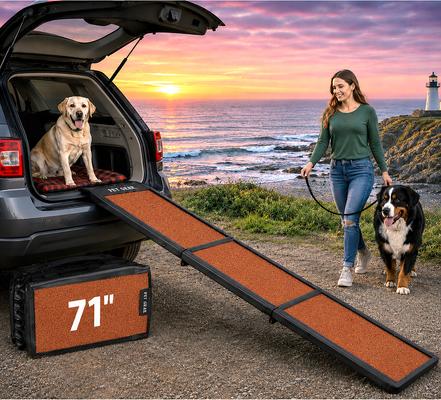 #1Browse Car Ramps & StepsActual product example shown: Pet Gear Full Length Tri-Fold Dog Car Ramp. This affiliate link opens a broader Chewy results page.Browse options ↗
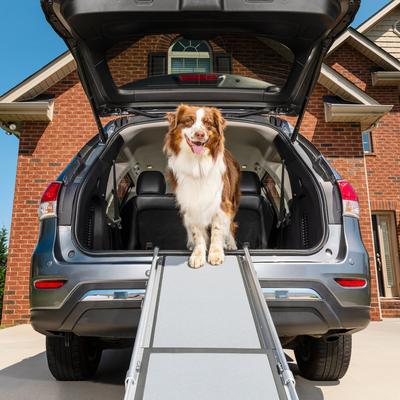 #2Browse Adjustable Car RampsActual product example shown: PetSafe Happy Ride Telescoping Dog Car Ramp. This affiliate link opens a broader Chewy results page.Browse options ↗
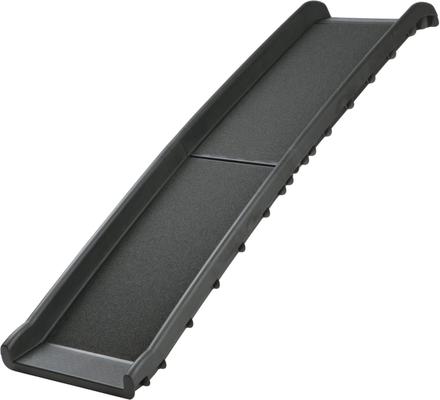 #3Browse Foldable Car RampsActual product example shown: TRIXIE Two-Fold Dog Car Ramp. This affiliate link opens a broader Chewy results page.Browse options ↗
Connect ramp safety to the complete vehicle route
For car travel, the ramp is only one part of the setup. Check the landing zone, secure restraint, break schedule, water, parked-car safety, and the destination route in our Senior Dog Road Trip Checklist. For the basic format decision, use the Dog Ramps vs. Stairs guide.
Give a new ramp time to become familiar
Do not assume refusal means the ramp is automatically wrong. A new surface, angle, or object can be unfamiliar. Introduce it calmly at a low or easy setup when possible, reward voluntary investigation, and avoid forcing a hesitant dog up or down.
If your dog shows pain, sudden weakness, repeated slipping, collapse, or a new change in mobility, a veterinarian should help assess the underlying problem before you rely on equipment alone.
Also check the landing route: if the ramp ends on hardwood, tile, or another slick surface, use our route-first traction plan for senior dogs on hard floors.