

💡 Cooper Analogy: Turn the house into a familiar trail
Think of your dog's everyday route like a trail with dependable landmarks. When vision or hearing becomes less reliable, the goal is not to redesign the whole house. Keep the important path predictable, easy to feel underfoot, well lit where useful, and free of surprise obstacles.
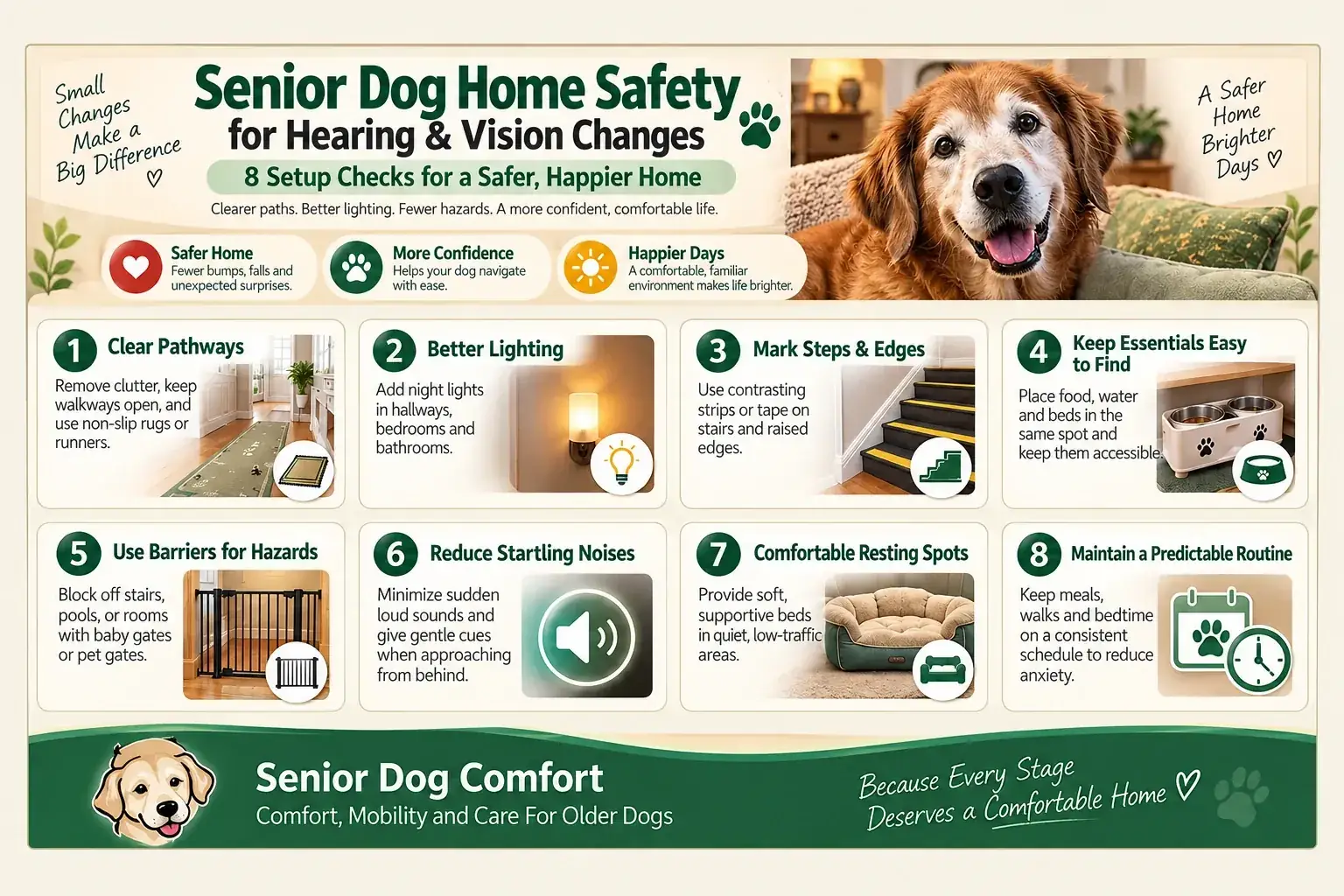
Senior dogs can experience changes in mobility, vision, hearing, and cognition. The American Animal Hospital Association (AAHA) recommends adapting the environment when those changes affect safety—for example, improving traction, reducing clutter, using gates around hazards, and keeping routines predictable. A new sensory change can also have medical causes, so home adjustments should support veterinary evaluation rather than replace it.
1. Keep the main route predictable
Avoid frequently moving furniture, beds, water stations, and other landmarks your dog uses every day. Clear narrow passages and remove low objects that can become unexpected obstacles. AAHA specifically advises removing obstructions and keeping the environment consistent for pets with sensory impairment.
2. Add useful light—not glare everywhere
AAHA notes that increased lighting or nightlights can help some senior pets navigate. Focus light on practical transition points such as the route from bed to water, a hallway turn, or the approach to a doorway. If your dog seems more hesitant in dim areas, that behavior is worth mentioning to your veterinarian.
3. Make the floor easy to read with the paws
Traction is useful for more than weak legs. Stable runners or mats can create a consistent tactile path across slick flooring. Secure every mat so its edges do not curl or slide. If slipping is already a problem, use our route-first hardwood traction guide rather than covering random spots.
4. Gate stairs, pools, and other high-consequence hazards
AAHA's senior-care guidance specifically calls out stairs and pools as hazards to identify when vision or hearing is limited. Use physical barriers where a navigation mistake could cause a serious fall. Do not rely on a dog hearing a verbal warning in time.
5. Change how you approach a dog who hears less
A dog who does not hear someone approaching may startle more easily. AAHA advises alerting sensory-impaired pets to your presence and notes that older dogs with hearing decline can be surprised by approaching people or animals. Approach where your dog can see you when possible, use gentle floor vibration or another familiar cue, and avoid suddenly grabbing a sleeping dog.
6. Keep bed, water, and door stations easy to find
Put essential stations in stable locations and keep their approaches clear. For water, our senior dog water-station guide covers bowl stability and slip prevention. For rest, bed placement should account for the route, turning room, temperature, and a secure landing zone.
7. Use routine as a navigation tool
Consistent feeding, potty, sleep, and family routines reduce the number of surprises a senior dog has to solve. This does not mean every day must be identical; it means the important cues and destinations stay understandable. If nighttime wandering is the main issue, see our separate night-route article, which focuses on pacing, waking, and veterinary escalation rather than sensory loss itself.
8. Treat new behavior as information, not just aging
Bumping into furniture, not responding to familiar sounds, disorientation, new fear, sudden irritability, or a rapid navigation change deserve attention. AAHA recommends veterinary evaluation for subtle sensory or behavior changes because hearing, vision, pain, cognition, and other health problems can overlap. Sudden vision loss, eye pain, repeated falls, collapse, severe disorientation, or other abrupt neurologic changes warrant prompt veterinary care.
A two-minute home check
- Can your dog reach bed, water, and the exit without new obstacles?
- Are slick transitions covered with secure, non-curling traction?
- Are stairs, pools, and unsafe drop-offs physically blocked?
- Is useful lighting available along the nighttime route?
- Do family members approach in a way that avoids startling the dog?
- Have you kept major furniture and daily stations in predictable places?
- Have you written down any new bumping, hesitation, startle, or disorientation?
Sources & evidence context
- AAHA — Lifestyle and Safety Assessment ↗
- AAHA — Supporting Senior Pets During Sensory Decline ↗
- AAHA — Living With a Blind or Deaf Pet ↗
- AAHA — Senior Care Kits & Environmental Modifications ↗
Evidence checked September 10, 2026. Educational information only; individual sensory and behavior changes should be evaluated by a veterinarian.