


Quick answer: for seven days, jot down a few repeatable details about your older dog’s sleep, getting comfortable, nighttime waking, appetite, water intake, and daily movement. A short log helps you notice patterns and gives your veterinarian concrete examples. It is an observation tool—not a diagnosis, and not a reason to delay care when symptoms are sudden or severe.
Why a seven-day log helps
Changes in an older dog’s routine can be gradual. You may notice that your dog takes longer to lie down, wakes more often, pants at night, changes sleeping spots, or walks less far before you can say when it began. Memory is useful, but small notes made at the time are easier to compare.
Keep the log simple enough to use every day. You do not need to measure every movement or keep your dog awake to observe them. Record what happens naturally, use the same wording each day, and note anything that differs from your dog’s usual pattern.
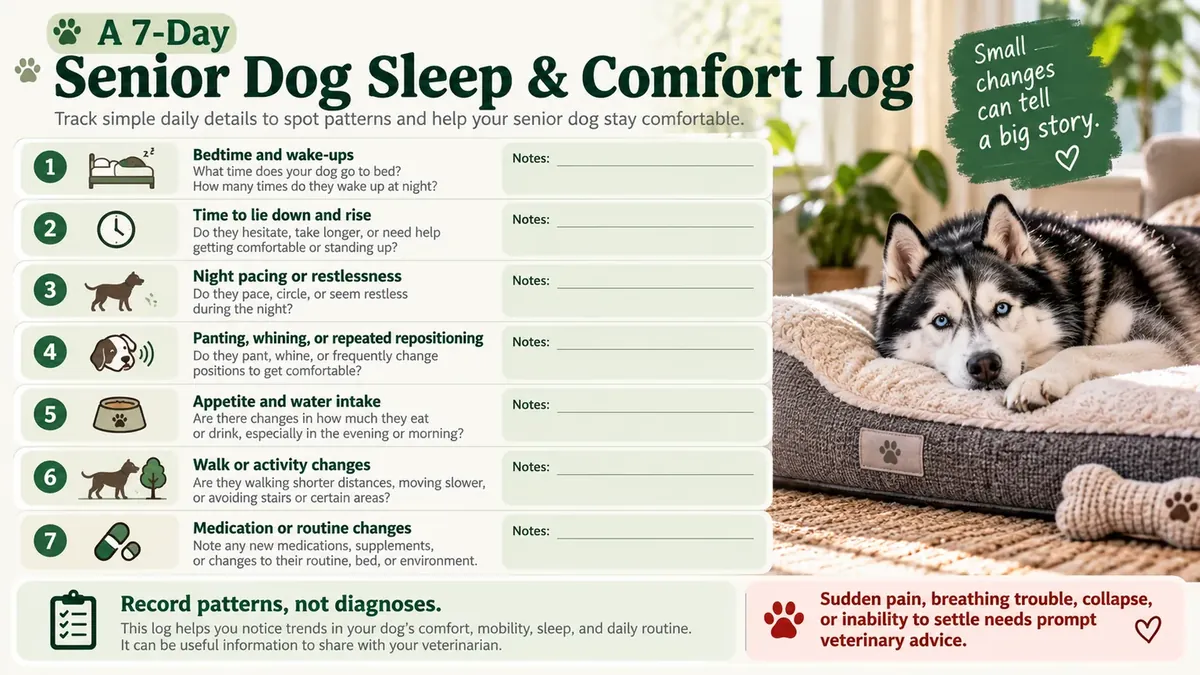
What to record each day
1. Bedtime and wake-ups
Note roughly when your dog settles, whether they wake during the night, and whether they can return to rest. A one-off wake-up is different from a repeated pattern across several nights.
2. Lying down and getting up
Write down whether your dog lowers themselves smoothly or hesitates, shifts repeatedly, slips, vocalizes, or needs help. Avoid repeatedly asking them to get up just to test them. Observe their normal movements instead.
3. Pacing, circling, or restlessness
Record when it happens, how long it lasts, and what seems to help. Mention whether your dog appears confused, needs to toilet, seeks water, or cannot find a comfortable position. Do not assume restlessness is simply old age.
4. Panting, whining, or frequent repositioning
Note whether the room was warm, your dog had recently exercised, or the behavior occurred while resting. Panting at rest, pain-related vocalizing, or a new inability to settle deserves attention rather than being dismissed as a sleep habit.
5. Appetite and water intake
Record noticeable changes in eating, drinking, or nighttime requests to go outside. If practical, note whether food or water was left untouched or needed replenishing more than usual. Do not restrict water to reduce overnight trips unless your veterinarian specifically directs you.
6. Walking and daytime activity
Capture changes you naturally see: shorter walks, slower starts, avoiding steps, reluctance to cross a floor, or more daytime sleeping. Add context such as weather, route, or an unusually busy day.
7. Changes in routine or treatment
Note changes in room temperature, bed location, household schedule, medications, or supplements, including when a new treatment began. Do not start, stop, or change medication based on the log without veterinary guidance.
A simple daily entry
Use a notebook or phone note and spend about one minute each evening. For example:
- Date: day and any unusual event.
- Night: settled normally / woke twice / paced for about ten minutes.
- Comfort: rose easily / hesitated / changed position repeatedly.
- Food and water: usual / more / less.
- Movement: usual walk / shorter route / avoided stairs.
- Question for the vet: one clear observation you want help interpreting.
Keep descriptions factual. “Took about 20 seconds to stand and then limped on the right front leg” is more useful than “seemed old.” If a behavior happens again, note the time and context. A short video of a naturally occurring movement may also help your veterinarian, as long as recording it does not delay care or put your dog at risk.
Make the resting area comfortable while you observe
Keep the bed easy to reach, on a stable surface, with a clear path to water and the usual toilet route. Make sure nearby rugs or mats do not slide or curl. Keep the room comfortably ventilated and avoid forcing your dog to climb onto furniture or use stairs they are struggling with.
Change one practical thing at a time when possible, and record what changed. That makes it easier to tell whether a new setup seems helpful. A better resting area can support comfort, but it cannot identify or treat the medical cause of new pain, panting, confusion, or mobility changes.
When not to wait for seven days
Do not wait to finish the log if your dog has sudden or severe symptoms. Seek prompt veterinary advice for sudden pain, repeated or worsening difficulty standing, new significant limping, a swollen abdomen, repeated vomiting, marked confusion, or inability to settle that is unusual for your dog. Labored breathing, collapse, pale or blue gums, or inability to stand can be emergencies.
If the change is gradual but persistent—such as waking repeatedly, drinking much more, struggling to rise, or losing interest in normal activity—contact your veterinarian and bring the notes. A log is most useful when it supports an examination, not when it delays one.
Common questions
Do I need to track every night?
Try to make a brief entry each day for a week, but do not worry about missing a detail. Consistent simple observations are more useful than an exhausting, overly detailed record.
Should I change my dog’s bed during the tracking week?
Make obvious safety improvements right away, such as securing a sliding rug or blocking unsafe stairs. For other changes, note what you changed and when. Do not keep an unsafe setup just to preserve a baseline.
Can this log tell me whether my dog has arthritis or cognitive changes?
No. The same behavior can have several causes. Share the pattern with your veterinarian, who can assess your dog’s history and decide whether an examination or tests are needed.
Sources and evidence limits
This guide focuses on recording observations, not interpreting them as a diagnosis. Its advice to discuss sleep, behavior, appetite, movement, and other changes with a veterinary professional is consistent with senior-care guidance from the American Animal Hospital Association’s age-and-behavior guidance and VCA Animal Hospitals’ senior dog care overview. These sources do not validate this specific seven-day log as a clinical scoring tool.
Related Senior Dog Comfort guides
- Senior Dog Restless at Night: What to Notice
- Why a Senior Dog May Be Slow to Get Up
- Where Should a Senior Dog Bed Go?
- Safer Nighttime Bed Transitions for Senior Dogs
Editorial note: This article is educational and is not veterinary advice. Record what you observe and consult your veterinarian about new, worsening, or concerning changes.