

The word “senior” on a dog-food package can be useful shopping shorthand, but it is not a complete nutrition decision. Before switching foods, turn the package around and read the sections that tell you what the food is formulated to do, how calorie-dense it is, and how it should be fed.
Direct answer
What should you look for on a senior dog food label?
Start with the nutritional adequacy statement, then compare calories, guaranteed analysis, moisture, ingredient list, intended use, and feeding directions. AAFCO recognizes gestation/lactation, growth, maintenance, and all life stages—not a separate “senior” nutritional life stage—so the word “senior” on the front does not by itself tell you whether a food fits your individual older dog.
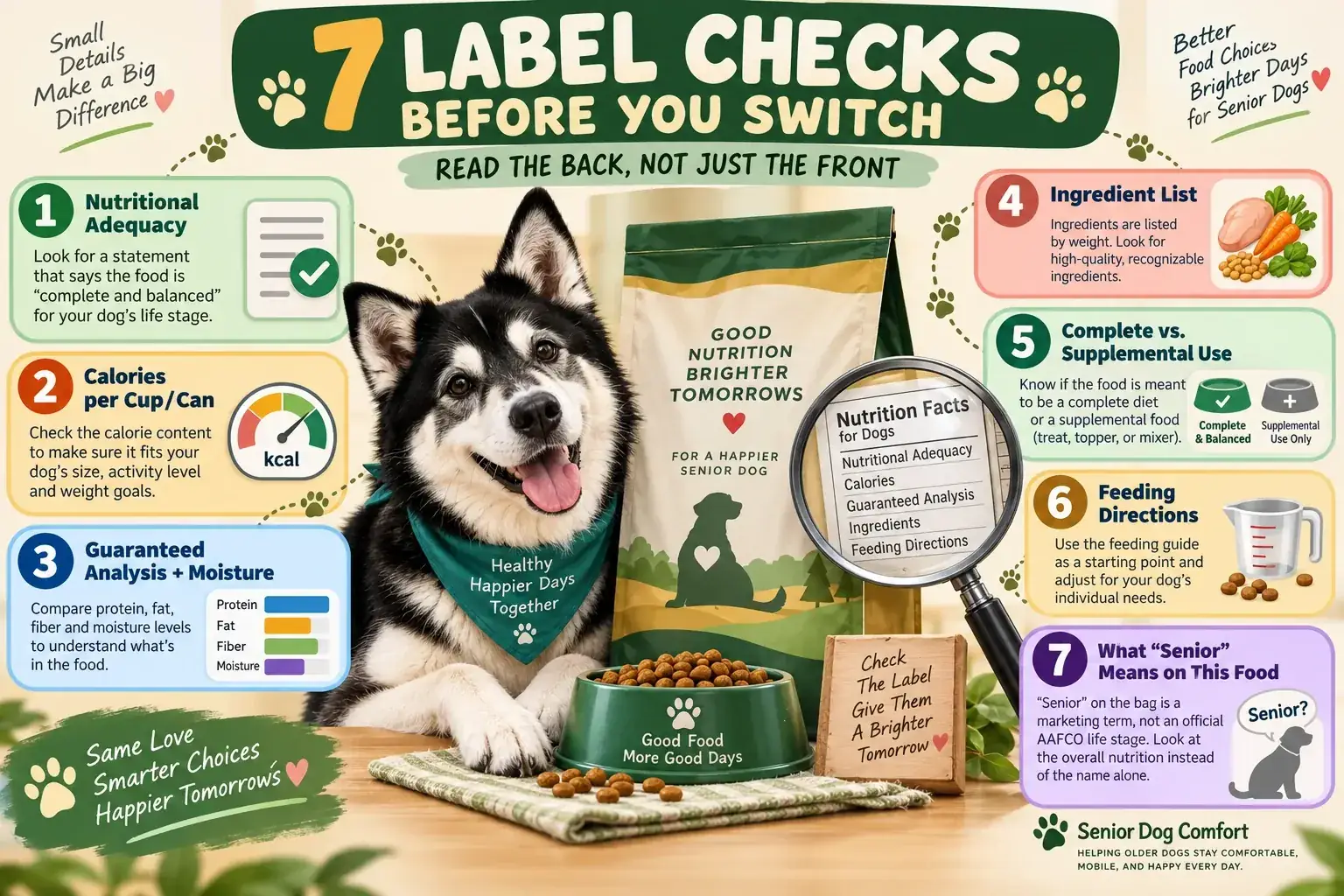
1. Find the nutritional adequacy statement first
AAFCO calls the nutritional adequacy statement one of the most important parts of the pet-food label. It tells you whether the product is intended to be complete and balanced and identifies the life stage or stages it is formulated to support.
Recognized AAFCO life stages include gestation/lactation, growth, maintenance, and all life stages. There is no separate AAFCO nutrient profile for “senior” dogs. AAHA likewise notes that there are no specific AAFCO nutritional requirements for mature, senior, or geriatric pets and that foods marketed for seniors can vary substantially.
2. Check calories per cup, can, or familiar unit
Look for the calorie statement rather than assuming that a food labeled “senior” is automatically lower in calories. AAFCO labeling guidance calls for calorie content to be expressed in kilocalories per kilogram and in a familiar household unit such as a cup, can, or biscuit.
Older dogs do not all need the same calorie direction. AAHA notes that energy needs often change with age, while advanced age can also bring weight or muscle loss. Use weight trends, body condition, muscle condition, activity, and veterinary guidance rather than choosing solely from the age wording on the package.
3. Read the guaranteed analysis—and the moisture number
The guaranteed analysis gives minimum or maximum amounts for specified nutrients such as crude protein, crude fat, fiber, and moisture. It is useful for screening foods, but wet and dry foods can look very different on an “as fed” label because the water content is different.
That means a canned food should not automatically be called “low protein” just because its printed percentage is lower than a kibble percentage. When a precise comparison matters, ask your veterinarian or the manufacturer for values on a comparable basis rather than relying on one front-label number.
4. Use the ingredient list for facts—not ingredient-list myths
Ingredients are listed in descending order by weight. That can help identify ingredients your veterinarian has asked you to avoid or verify. But the ingredient list does not tell you the exact amount of every ingredient and does not, by itself, prove the overall nutritional quality of the finished diet.
Instead of choosing a food because one fashionable ingredient appears near the top, connect the ingredient list to the dog in front of you: known sensitivities, veterinary recommendations, current diet, medication, and the purpose of the food.
5. Notice “complete and balanced” versus supplemental use
FDA explains that a food described as complete and balanced in its nutritional adequacy statement is intended to be nutritionally complete as a sole diet for the specified use. Treats, snacks, toppers, and supplements often are not designed to replace the main diet and may be labeled for intermittent or supplemental feeding.
This matters when a senior dog loves a topper or soft add-on. A product can be appealing and useful without being nutritionally appropriate as most of the daily diet.
6. Treat feeding directions as a starting estimate
AAFCO notes that feeding directions are guidelines that may need modification for an individual animal. VCA also recommends portion feeding older dogs because measured meals make it easier to control calories and notice whether intake has changed.
Use the package directions to establish a starting point, then watch body weight, body condition, muscle condition, appetite, stool quality, and activity. A veterinarian can help adjust the plan when those signals change.
7. Ask what “senior” means on this particular food
Because there is no single standardized senior-dog nutrient profile, two foods with “senior” on the front can have different calorie densities, fiber levels, protein levels, ingredient choices, and intended use. AAHA advises making nutrition recommendations for the individual pet rather than automatically switching food at a particular birthday.
If your older dog is doing well on a complete and balanced maintenance diet, age alone does not automatically mean a switch is required. If body condition, muscle condition, appetite, digestion, dental comfort, or a medical condition changes, the decision becomes more individualized.
60-second label check
Seven things to find before the bag goes in the cart
- Nutritional adequacy statement.
- Life stage or intended use.
- Calories per cup, can, or familiar unit.
- Guaranteed analysis and moisture.
- Ingredient list relevant to your dog’s needs.
- Complete-and-balanced versus intermittent/supplemental wording.
- Feeding directions—and a plan to adjust for the individual dog.
When should a food change involve your veterinarian?
AAHA nutritional risk factors include unexplained weight change, muscle loss, gastrointestinal changes, dental problems, medical conditions, and medication or supplement use. Those are reasons to make the diet decision with your veterinary team rather than treating the package label as a diagnosis tool.
Contact your veterinarian for a new or persistent loss of appetite, unexplained weight or muscle change, repeated vomiting or diarrhea, trouble chewing or swallowing, or a medical condition that may require a therapeutic diet. Do not use a general “senior” food to replace a veterinarian-directed diet for a diagnosed condition.
Sources & evidence context
- AAFCO — Reading Labels ↗
- AAFCO — Selecting the Right Pet Food ↗
- FDA — “Complete and Balanced” Pet Food ↗
- AAHA — Senior Care Guidelines: Nutrition ↗
- VCA — Feeding Mature and Senior Dogs ↗
Educational information only. Nutrition needs vary by dog and health status; this article does not replace veterinary advice.